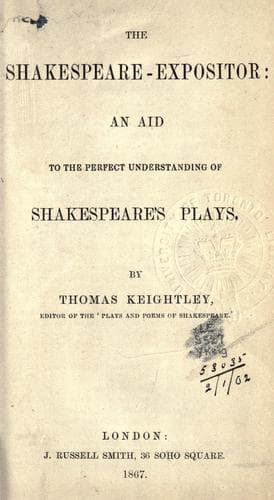
The Shakespeare-Expositor: An Aid to the Perfect Understanding of Shakespeare's PlaysKeightley, Thomas
General
The Shakespeare-Expositor: An Aid to the Perfect Understanding of Shakespeare's Plays
Keightley, Thomas
Drama -- Outlines, syllabi, etc.; Shakespeare, William, 1564-1616 -- Outlines, syllabi, etc.
* * * * *
"Thanks you, the valiant of this warlike isle."
The reading of the folio, with 'this' for _the_ from the 4tos, which
read '_worthy_ isle.'
* * * * *
"And in the essential vesture of creation
Does bear all excellency."
This is the reading of the 4to; the folio reads in the second line,
'Does tyre the ingenieur,' of which it seems almost impossible to make
any good sense. 'The essential,' etc., means person, body, form.
* * * * *
"If this poor trash of Venice, whom I trace
For his quick hunting, stand the putting on."
This is the reading of the folio; the 4to 1622 has _crush_ for 'trace';
and Warburton, followed by Steevens, Singer, and Dyce, read _brach_ for
'trash.' These last-named critics read the whole line thus: "If this
poor _brach_ of Venice whom I _trash_." "The jingle," Steevens says,
"being in Shakespeare's manner." Now to this I object--first, that this
was not Shakespeare's manner, for the apparent instances of it are
mostly printers' blunders; and secondly, that Roderigo did not require
to be _trashed_ or checked 'for his quick hunting,' for he was always
hanging back and ready to give up the chase till urged on by Iago.
This last objection also applies to 'trace' in the sense of follow or
accompany.
"Can _trace_ me in the tedious ways of art,
Or hold me pace in deep experiments."
1 Hen. IV. iii. 1.
It would also apply, though in a less degree, to _train_, which would
yield a tolerable sense. On the whole, I think that Iago's words may
have been _praise_, which would suit his sneering ironical tone. As to
'brach,' though we frequently find it used of a woman, I believe it was
never applied to a man.
* * * * *
SC. 3. "And passion having my best judgement collied."
The reading _quelled_, approved by Collier, is not so absurd as Singer
thinks it.
* * * * *
"In night and on the court and guard of safety."
This is the reading of all the old copies. Malone read 'of guard and
safety,' making the necessary transposition.
* * * * *
"Probal to thinking."
As I have never met with the word 'Probal' elsewhere, I think it may be
a mere misprint for _probable_.
* * * * *
"As the free element[s]."
It is the air that is meant, which was called 'the element.' See on Tw.
Night, i. 1, and on Temp. v. _ad fin_.
ACT III.
SC. 3. "Save that they say the wars must make examples
Out of her best."
There is an error either in 'wars' or in 'her,' and perhaps the
simplest correction is to read _war_. For 'her' Rowe, who is usually
followed, read _their_. Singer reads _the_.
* * * * *
Public-domain text, read in full here on John Shaqi.
Reviews
Reviews
No reviews yet
Be the first to share your thoughts on this work.
Elsewhere in the archive
Join the Discussion
Join the discussion
Sign in to leave a comment or review.
Sign InorCreate an account