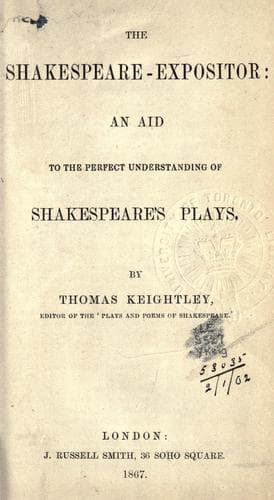
The Shakespeare-Expositor: An Aid to the Perfect Understanding of Shakespeare's PlaysKeightley, Thomas
General
The Shakespeare-Expositor: An Aid to the Perfect Understanding of Shakespeare's Plays
Keightley, Thomas
Drama -- Outlines, syllabi, etc.; Shakespeare, William, 1564-1616 -- Outlines, syllabi, etc.
Malone has shown from North's Plutarch that _persuade_, not 'dissuade,'
was the poet's word. In the first line for 'and' I read _He_, which may
have been written _A_'.
* * * * *
SC. 7. "Cæsar himself has work, and our oppression
Exceeds what we expected."
The right word is 'opposition,' also the reading of Hanmer and
Warburton.
* * * * *
"And let the Queen know of our guests."
He had no guests. Theobald read _gests_, which must be right, though
Shakespeare uses it nowhere else.
* * * * *
"Each man's like me; you have shown _yourselves_ all Hectors."
* * * * *
SC. 9. "Hark! the drums
Demurely wake the sleepers."
It is rather remarkable that Mr. Dyce and I should have simultaneously
conjectured _Do merrily_, of which I think there can be little doubt.
See Introd. p. 67.
* * * * *
SC. 10. "_And_ they have put forth the haven * *"
Rowe proposed _Further on_; Capell _Hie we on_; Tyrwhitt _Let us go_;
and Malone _Let's seek a spot_. I read "_We'll take our stand_."
* * * * *
"But being charg'd we will be still by land."
Here both 'But' and 'still' may cause some difficulty. The former is to
be taken in its original and proper sense, except, unless; the latter
in the sense of quiet.
* * * * *
"The hearts
That spaniel'd me at heels."
The folio has _pannell'd_; Hanmer made the correction.
* * * * *
"Oh! this false soul of Egypt! this grave charme."
In my Edition, yielding to an impulse I could not resist, I have
added a final _r_ to 'charme' both here and a few lines before; thus
making it accord with 'witch' and 'gypsy,' as he also calls her. But
he likewise terms her 'spell,' and Perdita (W. T. iv. 3) is called
'enchantment,' both, however, in the vocative. It is also rather
improbable that the last letter of the same word should have been
effaced in two places; but this may be explained by supposing an
effacement of the ends of many of the lines in a page of the MS.; and
while the others were restored, 'charme,' as making sense, was not
supposed to have been injured. By 'Egypt' is meant the Queen, so styled
elsewhere also. 'Grave' is heavy, powerful, oppressive; as in the
_gravibus Persis_ of Horace, Carm. iii. 5. 4.
* * * * *
"And hoist thee up _un_to the shouting plebeians."
* * * * *
SC. 12. "That which is now a horse, even with a thought
The rack dislimns, and makes it indistinct."
It might be better to read _dislimbs_.
* * * * *
"Pack'd cards with Cæsar['s]."
* * * * *
"Unarm _me_, Eros; the long day's work is done."
Public-domain text, read in full here on John Shaqi.
Reviews
Reviews
No reviews yet
Be the first to share your thoughts on this work.
Elsewhere in the archive
Join the Discussion
Join the discussion
Sign in to leave a comment or review.
Sign InorCreate an account