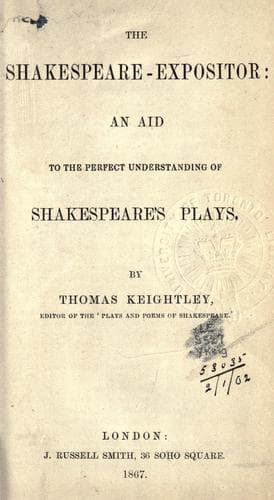
The Shakespeare-Expositor: An Aid to the Perfect Understanding of Shakespeare's PlaysKeightley, Thomas
General
The Shakespeare-Expositor: An Aid to the Perfect Understanding of Shakespeare's Plays
Keightley, Thomas
Drama -- Outlines, syllabi, etc.; Shakespeare, William, 1564-1616 -- Outlines, syllabi, etc.
and what excellent sense emerges! 'Subtle' (or, as we should now write,
_subtile_), used also by Chapman (Odyss. x. 296) of Circe's web, is
_subtilis_, 'fine-spun'; and the 'broken woof' is the web torn by
Minerva; 'admits' is allows of, _i.e._ contains; for 'orifice' the
originals have _orifex_. As Shakespeare was a great reader of Golding's
Ovid, Ariachne could never have been _his_ word. A perfect parallel to
the embarrassed structure of this passage is offered by
"That have sod their infants in--and after eat them--
The brine they wept at killing 'em; then if."
Two Noble Kinsmen, i. 3.
Which should be:
"That have sod their infants in the brine they wept
At killing 'em, and after eat them; then if."
(See on Cymb. i. 7.) The meaning of this very obscure passage is,
that there could not be now even the slightest doubt of Cressida's
infidelity, incredible as it might seem. 'Instance' in the following
lines is, proof.
* * * * *
SC. 3. "It is as lawful
For we would count give much to as violent thefts."
This is pure nonsense. The first 'as' cannot be right, and it probably
gave origin to the second. I read with confidence,
"It is unlawful
For we would give much count to violent thefts."
In my Edition I read '_so_ to,' but it is needless. 'Count' is account,
importance, value.
"Thieves for their robbery have authority
When judges steal themselves."
Meas. for Meas. ii. 2.
TIMON OF ATHENS.
ACT I.
SC. 1. "My free drift
Halts not particularly, but moves along
In a wide sea of wax. No levell'd malice
Infects one comma in the course I hold,
But flies an eagle's flight, bold and forth on,
Leaving no tract behind."
There is much here that seems dubious. _Holds_ might seem preferable to
'Halts'; yet I would make no change; for 'Halts not particularly,' I
think, may mean stops at, dwells on, no individual. For 'wax' we might
read, as has been proposed, _verse_; but the allusion may be to the
waxed tables on which the ancients wrote. We might also read _Which_
for 'But,' yet it is more probable that a line is lost before it.
* * * * *
"To those have shut him up; which failing _him_."
So Capell also; 2nd folio to _him_.
* * * * *
"My friend when he must need me."
Better, perhaps, with 3rd folio, _most needs_.
* * * * *
"Therefore he will be, Timon."
Public-domain text, read in full here on John Shaqi.
Reviews
Reviews
No reviews yet
Be the first to share your thoughts on this work.
Elsewhere in the archive
Join the Discussion
Join the discussion
Sign in to leave a comment or review.
Sign InorCreate an account