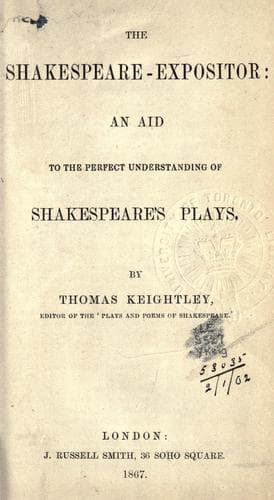
The Shakespeare-Expositor: An Aid to the Perfect Understanding of Shakespeare's PlaysKeightley, Thomas
General
The Shakespeare-Expositor: An Aid to the Perfect Understanding of Shakespeare's Plays
Keightley, Thomas
Drama -- Outlines, syllabi, etc.; Shakespeare, William, 1564-1616 -- Outlines, syllabi, etc.
So the folio reads; an evident misprint for _contemning_. The
aposiopesis removes all need of alteration. The usual reading is
_contending_, that of 2nd folio.
* * * * *
"Catched it again; or whether his fall enraged him."
The usual substitution of _or_ for _and_.
* * * * *
SC. 4. "No, nor a man that fears you less than he,
That's lesser than a little."
I read, with Johnson, _but_ for 'nor.'
* * * * *
"Fool-hardiness! not I.--Nor I.--_Nor I._"
* * * * *
"And, when it bows, stands up. Thou art left, Marcius ...
A carbuncle entire, as big as thou art,
Were not so rich a jewel."
A line at least has, I think, been left out after the first; or there
may be an aposiopesis.
* * * * *
SC. 6. "The Roman gods
Lead their successes," etc.
It is evident from the context that the poet wrote _Ye_, not 'The,' as
in Ant. and Cleop. v. 2. They were written alike.
* * * * *
"The mouse ne'er shunn'd the cat as they did budge
From rascals worse than they."
'Budge' in its present sense seems to be a very feeble term; but in
Cole's Dictionary we have "To budge, _pedem referre_;" and in 3 Hen.
VI. i. 4,
"With that we charg'd again; but out, alas!
We _bodg'd_ again."
There seems to be an allusion to deer in 'rascals.' We had the same
allusion above in
"Thou rascal, that art worst in blood to run,
Leadest first to win some vantage."
* * * * *
"And four shall quickly draw out my command
Which men are best inclined."
I read _forth_ for 'four'; 'command' is the nom. to 'draw.'
* * * * *
SC. 7. "Hence, _then_, and shut your gates upon us."
* * * * *
SC. 8. "That was the whip of your bragg'd progeny."
Here 'bragg'd' is, bragged of, that you brag of; 'progeny' progenitors,
and 'whip' the implement with which they scourged their foes. Chaucer
(Tr. and Cr. ii.) terms Hector the "Grekis _yerd_."
* * * * *
SC. 9. "When steel grows
Smooth as the parasite's silk, let him be made
An overture for the wars."
By 'him' in the second line can only be meant the parasite, and what is
the meaning of his being an 'overture for the wars'? I feel convinced
that it is a printer's error for a noun; and I read _pipes_, which
might be thus mistaken. The meaning then would be, when things are so,
let pipes and tabors, not trumpets and drums, be used in our armies,
grown thus effeminate.
"My throat of war be turn'd,
Which quired with my drum, into a pipe
Small as a eunuch's," etc.--iii. 2.
* * * * *
Public-domain text, read in full here on John Shaqi.
Reviews
Reviews
No reviews yet
Be the first to share your thoughts on this work.
Elsewhere in the archive
Join the Discussion
Join the discussion
Sign in to leave a comment or review.
Sign InorCreate an account