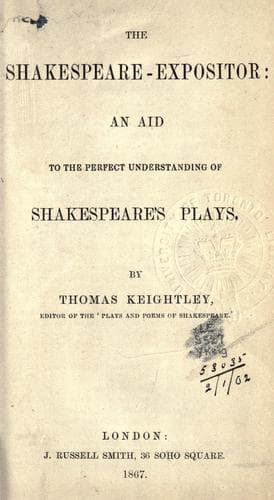
The Shakespeare-Expositor: An Aid to the Perfect Understanding of Shakespeare's PlaysKeightley, Thomas
General
The Shakespeare-Expositor: An Aid to the Perfect Understanding of Shakespeare's Plays
Keightley, Thomas
Drama -- Outlines, syllabi, etc.; Shakespeare, William, 1564-1616 -- Outlines, syllabi, etc.
The following plays also were published during Shakespeare's life-time
with his name, in full or in initials, on the title-pages: Locrine,
1595; The Life of Sir John Oldcastle, 1600--known to be by Munday,
Drayton, Wilson, and Hathway; History of Thomas Lord Cromwell, 1602;
The London Prodigal, 1605; The Puritan, or The Widow of Watling Street,
1607; A Yorkshire Tragedy, 1608. These, with Pericles, Prince of
Tyre--also published under his name in 1609--were printed in the 3rd
folio, 1664, and reprinted in the 4th, 1685, and finally by Rowe in his
edition of Shakespeare's Plays. The Two Noble Kinsmen, by Fletcher and
Shakespeare, was published in 1634.
Of the first six of these plays the opinion of the critics is tolerably
unanimous that Shakespeare had nothing whatever to do with them. Yet,
as in Locrine (printed so early as 1595) it is said, "newly set forth,
overseen and corrected, by W. S." it is possible, though most unlikely,
that it may be one of the plays on which he operated in the early part
of his dramatic career; and the fame of his Poems lately printed, may
have induced the publisher to place his initials in the title-page. As
to Pericles, it was rejected, with Locrine, &c., by Pope, Theobald,
and all the editors down to Malone, who printed all these pieces in
1780 in the Supplement to the edition of Johnson and Steevens; he did
not, however, include any of them in his own edition of 1790. Steevens
admitted Pericles into his edition of 1793 on the authority of Farmer,
but marked with an asterisk, as being only in part Shakespeare's, to
which opinion Malone, who at first thought it wholly his, acceded. It
finally was included in Reed's and in the Boswell-Malone or Variorum
edition, which succeeding editors have followed. From _mine_ it has
been excluded, as I am most firmly of opinion that it does not contain
a single line of Shakespeare's, and that it is an insult to his memory
to give it a place among his genuine works. In fact the deliberate
rejection of it by Heminge and Condell from the folio ought to outweigh
all conjectural proofs in its favour. These, we must recollect, were
not ordinary players, they were Shakespeare's _fellows_ or partners in
the theatres; and it was therefore utterly impossible that any play
could be acted there without their knowing who was the author. They
must, then, have _known_ that Shakespeare had had nothing to do with
it; for their admission of 1 Hen. VI. and Titus Andronicus proves that
evidence even of the slenderest kind would have turned the beam with
them. His name at full length in the title-page proves nothing; for it
is also in that of Sir John Oldcastle, 1600, which is _known_ not to be
his.
Public-domain text, read in full here on John Shaqi.
The Shakespeare-Expositor: An Aid to the Perfect Understanding of Shakespeare's Plays — John Shaqi
Reviews
Reviews
No reviews yet
Be the first to share your thoughts on this work.
Join the Discussion
Join the discussion
Sign in to leave a comment or review.
Sign InorCreate an account