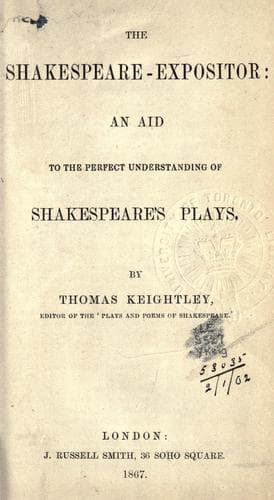
The Shakespeare-Expositor: An Aid to the Perfect Understanding of Shakespeare's PlaysKeightley, Thomas
General
The Shakespeare-Expositor: An Aid to the Perfect Understanding of Shakespeare's Plays
Keightley, Thomas
Drama -- Outlines, syllabi, etc.; Shakespeare, William, 1564-1616 -- Outlines, syllabi, etc.
As to the Two Noble Kinsmen, it was published in 1634 as "written by
the memorable worthies of their time, Mr. John Fletcher and Mr. William
Shakespeare"--putting the greater last--an evident bookseller's
artifice; for surely Shakespeare at the zenith of his fame, and toward
the close of his dramatic career, would not join with a young poet in
the composition of a play, a thing that he never seems to have done,
even when he was a young poet himself. Mr. Dyce, who had rejected,
afterwards adopted the theory of its being in a certain sense a joint
composition; and he makes some strange hypotheses upon the subject,
which to me seem utterly devoid of probability. Surely, for example,
it is not to be supposed that a man of Shakespeare's business-habits
would, when winding-up, as we may term it, leave behind him, in the
hands of the House, an unfinished drama, and that what he left should
have been the beginning and the end of a play! It is pretty generally
agreed that the entire play, except the first and fifth acts, is by
Fletcher. To me it seems certain that the first act, though the work
of a superior poet, is not Shakespeare's; and I feel quite confident
that the first, as well as the second, scene of the last act is by
Fletcher; while the concluding scenes are by some other poet, different
from, and, I think, superior to, the writer of the first act. My theory
is, that Fletcher either obtained the commencement of a play by some
one else, or began to write in conjunction with some one, and, the
play being unfinished at his death, it was concluded by another poet,
possibly Massinger, who alone seems capable of writing such a noble
termination of so fine a drama.
THE TEXT
CORRECTED AND ELUCIDATED.
INTRODUCTION.
I. THE TEXT. II. THE VERSE.
COMEDIES.
HISTORIES.
TRAGEDIES.
INTRODUCTION.
I. THE TEXT.
1.
Public-domain text, read in full here on John Shaqi.
Reviews
Reviews
No reviews yet
Be the first to share your thoughts on this work.
Join the Discussion
Join the discussion
Sign in to leave a comment or review.
Sign InorCreate an account