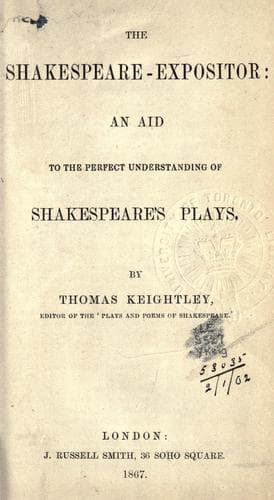
The Shakespeare-Expositor: An Aid to the Perfect Understanding of Shakespeare's PlaysKeightley, Thomas
General
The Shakespeare-Expositor: An Aid to the Perfect Understanding of Shakespeare's Plays
Keightley, Thomas
Drama -- Outlines, syllabi, etc.; Shakespeare, William, 1564-1616 -- Outlines, syllabi, etc.
The omission is generally, as in these cases, of single words, from
noun to interjection, all parts of speech included, and also of single
letters or syllables. It is rather curious, too, that when a word has
been repeated by the poet it is sometimes omitted by the printer. Thus
"What wheels? what racks? what fires?" W. T. iii. 2, is printed, "What
wheels? racks? fires?" There is another instance in the same play,
and many in the other plays. In Chaucer the instances are numerous.
Addresses, as _sir_, _my lord_, etc., are sometimes left out, as
also are _pray_, _now_, _only_, and others which are not absolutely
necessary for the sense--and even two or more words; in all which cases
the omission is indicated by the defect of metre. This the reader
will do well to keep constantly in mind. For an example see on Tam.
of Shrew, i. 1. It is surprising how often the negative particle is
wanting in these plays of Shakespeare's. I have discovered its absence
in between twenty and thirty places, not one-half of which had been
observed by preceding editors. But not merely single words have been
left out by printers; want of rime or want of connexion shows that
entire lines have been omitted. Mr. Collier observes that three lines
are wanting in various places of the Variorum Shakespeare; and such
being the case in the present century, we need not wonder at so many
having been passed over by the original printers. The reader will find
about two dozen such cases noticed in my Edition and in the following
pages, not one-half of which had been observed by preceding editors.
Shakespeare himself furnishes the following remarkable instance. In
Com. of Err. ii. 2, the three last folios omit the two lines beginning
with "Wear gold and no man," etc. Nares gives in his Glossary (_v._
Portingall) a curious instance of the omission of a line, which escaped
the author's own notice in the proof-sheet. So also in Massinger's
Unnatural Combat, lines are wanting in two places, though he himself
must have read the proofs. In 2 Hen. VI. iv. 1, there is a line wanting
in the folio, to recover which we are actually obliged to go to the
original play of The Contention, etc.
Parts of lines, generally the latter part, are also often wanting, but
not so often as it may seem; for short lines, and also over-long lines,
generally are caused by malarrangement of the text. The main cause,
however, of these losses is the ill-usage to which the manuscripts seem
to have been subjected in the part of the theatre in which they were
kept, and the careless treatment of them by those who had occasion to
use them. Hence in some places the writing may have been obliterated
by ink-blots, in others effaced by friction, or by damp or dust; while
sometimes a part of a leaf may have been torn away. We must remember
that a large number of Shakespeare's plays were lying thus exposed to
ill-usage, probably in the property-room of the Globe or Blackfriars,
for a space of from twenty to thirty years.
Public-domain text, read in full here on John Shaqi.
Reviews
Reviews
No reviews yet
Be the first to share your thoughts on this work.
Elsewhere in the archive
Join the Discussion
Join the discussion
Sign in to leave a comment or review.
Sign InorCreate an account