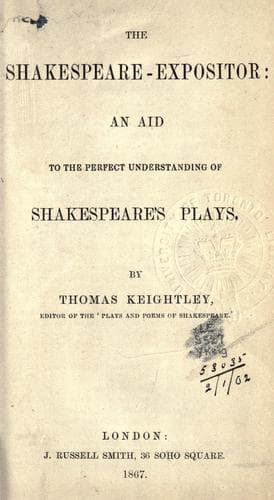
The Shakespeare-Expositor: An Aid to the Perfect Understanding of Shakespeare's PlaysKeightley, Thomas
General
The Shakespeare-Expositor: An Aid to the Perfect Understanding of Shakespeare's Plays
Keightley, Thomas
Drama -- Outlines, syllabi, etc.; Shakespeare, William, 1564-1616 -- Outlines, syllabi, etc.
The parts most likely to have thus sustained injury must have been
those nearest the edges of the page; and hence the part effaced would
be the beginning of the line or the end of it; and as the lines run
evenly at the beginning, while they are of irregular length, the
effacement at the beginning would be in general of mere monosyllables,
as _I_, _in_, _with_, _and_, &c., while that at the end might be of
several words, at times even of half a line. In the beginning, too--as
will be seen in the notes on Merchant of Venice, iv. 1, As You Like It,
ii. 7, and elsewhere--more than one word has been sometimes effaced.
In the case of entire lines or large parts of lines, the cause may
have been their position at the top or bottom of the page, and their
consequent proximity to the edge.
It is rather strange that I should have been--as I believe I am--the
first to notice this very simple and natural mode of accounting for the
losses in the text. The number of these losses which I have, or seem
to have, detected in the beginnings is over seventy, those at the ends
more than double that number. As they are all supplied in my Edition,
and noted in the following pages, the reader will have ample occasion
for ascertaining whether my theory is correct or not. I will here,
however, give a couple of instances.
In faith, my lord, you are too wilful-blame.
1 Hen. IV. iii. 1.
Here the critics are perplexed with "wilful-blame," which is a
compound without example; but let us suppose that the poet wrote
"wilful-blameable," and that the final letters had been effaced, we get
a compound term of which examples are numerous. The other is,
And made him stoop to the water. 'Tis wonder_ful_.
Cymb. iv. 2.
In the following pages it will be seen that occasionally I attempt to
supply the losses of lines and parts of lines. It will not, I hope,
be supposed that I am so presumptuous as to expect my productions to
be admitted into the text. My object has merely been, by showing how
easily and naturally something could be supplied, to make the reader
see more clearly that something had been lost. In three places, however
(All's Well, i. 1, Tr. & Cr. ii. 1, Cor. ii. 3), I have ventured to
place them in the text of my Edition.
I must, in fine, request the reader most earnestly not to pooh-pooh
this principle of effacement, but to keep it steadily in mind in
reading the other dramatists, as well as Shakespeare; for he will find
it a most valuable aid. Among the instances of effacement at the end
is to be noted that of compound words of which the last part has been
lost. In five places I have thought myself justified in supplying the
missing word, namely, Winter's Tale, i. 2, Rich. III. v. 3, Ham. iii.
4, Tim. i. 2, ii. 2; for it is almost only at the end of a line that we
ever find reason to suspect this kind of effacement.
Public-domain text, read in full here on John Shaqi.
Reviews
Reviews
No reviews yet
Be the first to share your thoughts on this work.
Elsewhere in the archive
Join the Discussion
Join the discussion
Sign in to leave a comment or review.
Sign InorCreate an account