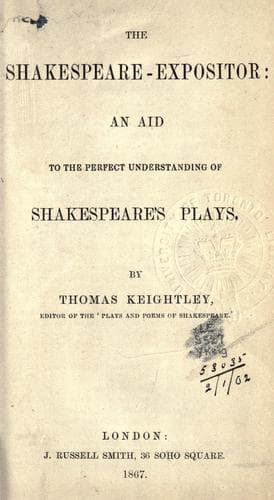
The Shakespeare-Expositor: An Aid to the Perfect Understanding of Shakespeare's PlaysKeightley, Thomas
General
The Shakespeare-Expositor: An Aid to the Perfect Understanding of Shakespeare's Plays
Keightley, Thomas
Drama -- Outlines, syllabi, etc.; Shakespeare, William, 1564-1616 -- Outlines, syllabi, etc.
I have printed 'hears' for the 'hairs' of the folio, as it rimes
with 'tears,' and was the constant pronunciation of Chaucer, and
frequently of Spenser; and in his early plays Shakespeare indulged
in riming archaisms of this kind occasionally. We are to recollect
that this play was not printed till thirty years after it had been
written, and by that time _hair_ had been established as the sole
orthography. The matter is, however, put out of dispute by the Poems,
in which Shakespeare himself spells it _hear_ when riming with _tear_
and _ear_. 'Bed' is the correction of 2nd folio for _bud_. Mr. Dyce
proposed _bride_.
* * * * *
"Call thyself sister, sweet, for I am thee."
For 'am' Capell read, I think rightly, _aim_, and Singer quotes "I make
my changes aim one certain end."--Drayton Leg. of Rob. Duke of Normandy.
* * * * *
"Well, sir, but her name and three quarters."
The folio has _is_ for 'and'; the correction is Thirlby's.
ACT IV.
SC. 1. "Belike you thought our love would last too long
If it were chain'd together."
For 'it' I think we should read _we_.
* * * * *
SC. 2. "First she denied you had in him no right."
This structure seems strange, but it was in use:--
"You may deny that God was not the cause."
Rich. III. i. 3.
"Fortune forbid my outside have not charm'd her."
Twelfth Night, ii. 2.
* * * * *
"Here go. The desk! the purse! Sweet, now make haste."
For 'Sweet,' which is rather free in the mouth of Dromio, Collier's
folio reads _Swift_; we might also conjecture _Speed_. The truth,
however, seems to be that _mistress_ has been omitted after 'Sweet.'
* * * * *
"A devil in an everlasting garment hath him."
There is something evidently lost here, riming with 'steel.' It may
have been _by the heels_, or _laid by the heels_, alluding to 'Tartar
Limbo'; but _still_, or _at his will_, seems preferable.
* * * * *
"A fiend, a fairy, pitiless and rough."
For 'fairy' Theobald proposed _fury_, and we have "O, my good lord,
deliver me from these _furies_" (_i.e._ bailiffs).--Massinger,
Fatal Dowry, v. 1. "Fiends, _fairies_, hags that fight in beds of
steel."--Peel, Battle of Aleazar, where Mr. Dyce reads _furies_. In
Jonson's Poetaster (iii. 1) the Lictors are termed _furies_.
* * * * *
SC. 3. "Master, if you do, expect spoon-meat, or bespeak a long
spoon."
For 'or' we should read _and_, as usual. Mr. Dyce reads _so_.
* * * * *
SC. 4. "In verity you did; my bones bear witness
That since have felt the vigour of his rage."
Public-domain text, read in full here on John Shaqi.
Reviews
Reviews
No reviews yet
Be the first to share your thoughts on this work.
Elsewhere in the archive
Join the Discussion
Join the discussion
Sign in to leave a comment or review.
Sign InorCreate an account