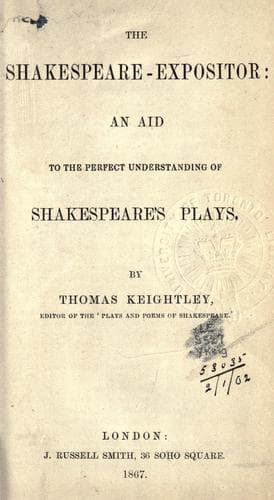
The Shakespeare-Expositor: An Aid to the Perfect Understanding of Shakespeare's PlaysKeightley, Thomas
General
The Shakespeare-Expositor: An Aid to the Perfect Understanding of Shakespeare's Plays
Keightley, Thomas
Drama -- Outlines, syllabi, etc.; Shakespeare, William, 1564-1616 -- Outlines, syllabi, etc.
"Master, shall I fetch your stuff from ship-board _now_?"
THE TWO GENTLEMEN OF VERONA.
ACT I.
SC. 1. "I leave myself, my friends, and all for love."
The folio has 'I _love_.' Pope made the obvious correction.
* * * * *
"But what said she? _did she nod?_"
These last words are an addition by Theobald, and the context shows
they had been lost.
* * * * *
SC. 2. "Yet he of all the rest I think best loves ye."
'Lov'_d_ ye' would rime better with 'mov'd me.'
* * * * *
"That I might sing it, madam, to a tune."
As _time_ and 'tune' were synonymous, perhaps the poet used the former,
which would accord with 'rime.'
* * * * *
"Let's see your song. _Why_, how now, minion!"
* * * * *
"You do not _like it_!--No, madam, it is too sharp."
* * * * *
"I see you have a month's mind to them."
A syllable is wanting. Some read _moneth_, but that is not a
Shakespearian form. We might also read '_un_to' for 'to' but I prefer
'I see _that_ you'; as I have given it in my Edition.
* * * * *
SC. 3. "And be in _the_ eye of every exercise."
ACT II.
SC. 1. "And now you are _so_ metamorphosed with a mistress."
A just and necessary addition of Collier's folio.
* * * * *
"And you, being in love, cannot see to put on your hose."
For 'hose,' apparently suggested by what went before, I should incline
to read, with the Cambridge editors, _shoes_; or _clothes_ might be
better.
* * * * *
"Nay, take them _again_--Madam, they are for you."
* * * * *
SC. 3. "Oh, that she could speak now like a wood woman!"
For 'she' Blackstone proposed _shoe_; better _the shoe_, as I have
given it.
* * * * *
SC. 4. "_Come_, go with me. Once more, new servant, welcome."
* * * * *
"She is alone.--Then let her _be_ alone."
* * * * *
"So the remembrance of my former love
Is, by a newer object, quite forgotten."
It seems to me that the best way to give sense to this passage is to
take 'by' in the sense of beside, near. See Index _s. v._
* * * * *
"It is mine or Valentine's praise?"
So it stands in the original. It need hardly be observed that the
two first words must be transposed. It is also plain to me that a
substantive has been lost after 'mine,' and none seems so likely to be
the right word as _eye_, the conjecture of Warburton, and which seems
to be omitted in the same manner in the last line of Son. cxiii.
Public-domain text, read in full here on John Shaqi.
Reviews
Reviews
No reviews yet
Be the first to share your thoughts on this work.
Elsewhere in the archive
Join the Discussion
Join the discussion
Sign in to leave a comment or review.
Sign InorCreate an account