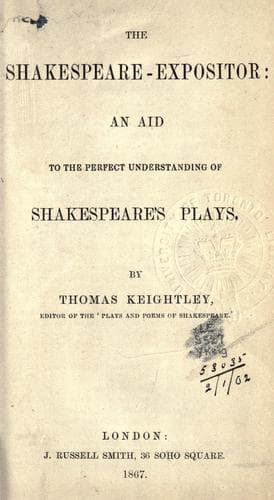
The Shakespeare-Expositor: An Aid to the Perfect Understanding of Shakespeare's PlaysKeightley, Thomas
General
The Shakespeare-Expositor: An Aid to the Perfect Understanding of Shakespeare's Plays
Keightley, Thomas
Drama -- Outlines, syllabi, etc.; Shakespeare, William, 1564-1616 -- Outlines, syllabi, etc.
Though in my edition I have made here an aposiopesis, I think it more
probable that a line has been lost.
ACT IV.
SC. 1. "_O_ sir, we are undone; these are the villains."
So Capell read also.
* * * * *
"An heir, and near-allied unto the Duke."
The folio has "And heir and niece." Theobald made the corrections.
* * * * *
"Come, go with us; we'll bring thee to our crews."
As in v.1 we have
"Come, I must bring thee to our captain's cave,"
we should probably read here _cave_ or _caves_ for 'crews.'
* * * * *
SC. 3. "Vain Thurio whom my very soul abhorred."
'Abhorreth' is probably what the poet wrote.
* * * * *
"Madam, I pity much your grievances,
Which since I know they virtuously are placed."
This is mere nonsense; 'grievance' never had any meaning but that
which it has at present. A line has evidently been lost; something
like this:--"_And sympathize with your affections_." The corrector of
Collier's folio, who first saw the loss, added--"_And the most true
affections that you bear_," which seems wanting in ease and simplicity.
* * * * *
"When will you go?--This evening coming _on_."
* * * * *
SC. 4. "It seems you loved not her, not leave her token."
For the second 'not' we should read _to_. See on All's Well, v. 3. For
'leave,' see Index _s. v._
* * * * *
"Why dost thou cry Alas?--I cannot choose
But pity her.--Wherefore should'st thou pity her?"
This is the proper arrangement; that of the editions, my own included,
is wrong.
* * * * *
"Well, give _to_ her that ring, and therewithal."
* * * * *
"From whom?--From Sir Proteus, my master, madam."
So I should have given it in my Edition.
* * * * *
"Aye, but her forehead's low, and mine's as high."
The sense might seem to require 'mine _is_ high,' as Pope also saw; but
her meaning may be, so is mine also. A high forehead was, however, a
part of beauty. See Fletcher, Woman-hater, iii. 1.
"She hath a freckled face,
A _low forehead_, and a lumpish eye."
Marston, Ant. and Mel. I. iv.
ACT V.
SC. 2. "Which of you saw _sir_ Eglamour of late?"
* * * * *
SC. 4. "And I mine _too_.--A prize! a prize! a prize!"
* * * * *
"Come let us go. We will include all jars
With triumphs, mirth, and rare solemnity."
'Include' here evidently signifies _conclude_; and as there is no
instance of its use in that sense, it might be better to read the
latter word with Hanmer.
LOVE'S LABOUR'S LOST.
ACT I.
SC. 1. "And then grace us in the disgrace of death."
Public-domain text, read in full here on John Shaqi.
Reviews
Reviews
No reviews yet
Be the first to share your thoughts on this work.
Elsewhere in the archive
Join the Discussion
Join the discussion
Sign in to leave a comment or review.
Sign InorCreate an account