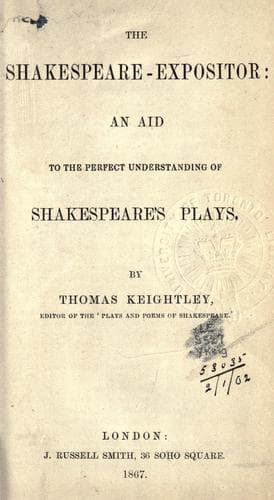
The Shakespeare-Expositor: An Aid to the Perfect Understanding of Shakespeare's PlaysKeightley, Thomas
General
The Shakespeare-Expositor: An Aid to the Perfect Understanding of Shakespeare's Plays
Keightley, Thomas
Drama -- Outlines, syllabi, etc.; Shakespeare, William, 1564-1616 -- Outlines, syllabi, etc.
Hanmer, who is generally followed, read 'sonnet_eer_'; but it is
doubtful if that term was then in use. In Hall's Satires we meet with
_sonnetist_; he also has _sonnet-wright_; and in Marston's Fawne (iv.)
and in the play of Lingua (ii. 2), we have _sonnet-monger_, which I
have adopted, as we have 'fancy-monger' in As You Like It, iii. 2.
Dr. Verplank, an American critic, proposed 'turnsonnets,' which Mr.
Staunton has adopted.
ACT II.
SC. 1. "_Lord_ Longaville is one."
* * * * *
"Well-fitted in arts, glorious in arms."
I read 'In arts well-fitted'; so also Grant White. The 2nd folio has
'in _the_ arts.'
* * * * *
"To the wide fields _is_ too base to be mine."
The metre requires a syllable.
* * * * *
"'Tis deadly sin to keep that oath, my lord,
And sin to break it."
Perhaps something may have been lost. It might be '_'tis no_ sin.'
* * * * *
"My lips are no common, though several they be."
'Several' is the very opposite of 'common.' "Truth lies _open_ to all;
it is no man's _several_."--Jonson, Discoveries. We should therefore,
I think, for 'though' read _for_, which is proved by the following
speeches. The printer might have taken _for_ for _tho'_, or have
supposed that 'be' was the conjunctive mood.
* * * * *
"Who tendering their own worth, from where they were glass'd,
Did point out to buy them, along as you pass'd."
The 4to reads 'point you'; but neither reading makes sense. We might
read '_prompt_ you,' or '_tempt_ you.' I have adopted the former.
* * * * *
"Come to our pavilion; Boyet is dispos'd."
By 'dispos'd' here we are to understand--like _dispos_ Fr.--cheerful,
or rather gamesome; we have _undis_posed in Com. of Err. i. 2. It would
seem, however, to be simply inclined with an ellipsis of the object.
ACT III.
SC. 1. "And make them men of note?--Do you note men?--that most are
affected to these."
I agree with the proposed reading of _me_ for the second 'men.'
* * * * *
"No salve in the male, sir."
Tyrwhitt's most happy emendation 'in them all' gives in my opinion, the
true reading.
* * * * *
"And stayed the odds by adding four."
Collier's folio, which Singer follows, reads _making_, which may be
right, but is not necessary.
* * * * *
"Sirrah Costard, _marry_, I will enfranchise thee."
Costard's reply shows that _marry_, added by Collier's folio, had been
omitted.
* * * * *
"I give thee thy liberty, set thee _free_ from durance."
The same folio supplies _free_. Singer received both corrections.
* * * * *
"Than whom no mortal so magnificent."
Public-domain text, read in full here on John Shaqi.
Reviews
Reviews
No reviews yet
Be the first to share your thoughts on this work.
Elsewhere in the archive
Join the Discussion
Join the discussion
Sign in to leave a comment or review.
Sign InorCreate an account