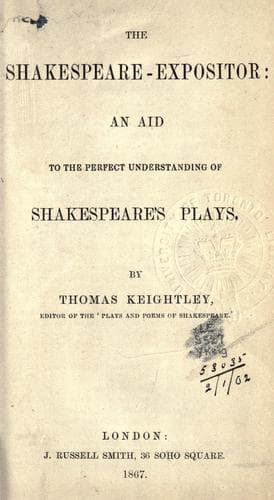
The Shakespeare-Expositor: An Aid to the Perfect Understanding of Shakespeare's PlaysKeightley, Thomas
General
The Shakespeare-Expositor: An Aid to the Perfect Understanding of Shakespeare's Plays
Keightley, Thomas
Drama -- Outlines, syllabi, etc.; Shakespeare, William, 1564-1616 -- Outlines, syllabi, etc.
A line has evidently been lost here.
* * * * *
"And every one his love-feat will advance."
For 'feat' Collier's folio, and S. Walker, followed by Singer and Dyce,
read _suit_, which I also have adopted.
* * * * *
"But while 'tis spoke each turn away her face."
Both 4to and folio read _his_ for 'her.'
* * * * *
"_Bero._ Beauties no richer than rich taffeta."
It should evidently be _Boyet_, as in my Edition.
* * * * *
"Yet still she is the moon and I the man."
The line riming with this is lost, as Malone also saw.
* * * * *
"_Oh!_ They were all in lamentable cases."
So also 2nd folio.
* * * * *
"Till this madman show'd thee? and what art thou now?"
The editors omit 'mad,' as it is what they deem a superfluous syllable.
We should perhaps omit 'thou' and retain 'mad.'
* * * * *
"This jest is dry to me. _Fair_, gentle, sweet."
_Fair_ is an addition of 2nd folio.
* * * * *
"Which of the visors was it that you wore?--
Where? When? What visor? Why demand you this?"
As the whole scene is in rime, there should be a couplet here. We might
then for 'this' read _more_.
* * * * *
"As precious eye-sight and did value me."
A line riming with this, before, or after, seems lost.
* * * * *
"Nay, my good lord, let me o'er-rule you now;
That sport best pleases, that does least know how,
Where zeal strives to content, and the contents
Dies in the zeal of that which it presents."
The whole difficulty of this place lies in the word 'dies,' which has
two senses, now distinguished by the orthography, namely, _die_ and
_dye_, but which in Shakespeare's time were spelt indifferently. In
this place editors have invariably taken it in the former sense; and as
they regard 'contents dies' as a false concord--which, by the way, it
is not--they print 'Die,' and then change 'that' to _them_, and alter
the punctuation. The result, however, is anything but satisfactory. I,
on the contrary--and I believe I have been the first to do so--take
'Dies' in its second sense of tinging, colouring, imbruing, making
'zeal' the subject and 'contents' the object, and regarding this last
as being by metonymy--a figure Shakespeare uses so frequently--the
persons contented, or to be contented, just as in Ant. and Cleop. i.
4. "The Discontents" are the discontented. All then becomes plain, and
the passage is parallel to one in the speech of Theseus in M. N. D. v.
1. As to using 'Dyes' of mind, we may justify it by the employment of
_tinge_ and _tincture_ in the same way in our ordinary language; and
the following passages are very apposite:--
Public-domain text, read in full here on John Shaqi.
Reviews
Reviews
No reviews yet
Be the first to share your thoughts on this work.
Elsewhere in the archive
Join the Discussion
Join the discussion
Sign in to leave a comment or review.
Sign InorCreate an account