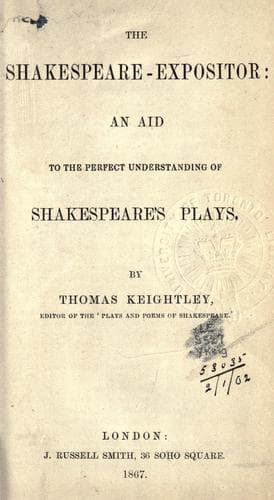
The Shakespeare-Expositor: An Aid to the Perfect Understanding of Shakespeare's PlaysKeightley, Thomas
General
The Shakespeare-Expositor: An Aid to the Perfect Understanding of Shakespeare's Plays
Keightley, Thomas
Drama -- Outlines, syllabi, etc.; Shakespeare, William, 1564-1616 -- Outlines, syllabi, etc.
* * * * *
"Advise him.--He cannot want the best _advice_."
* * * * *
"And these great tears grace his remembrance more
Than those I shed for him.... What was he like?"
For 'his' I read _this_, i.e. that of Bertram, whose departure has
caused her tears to flow. There is an evident aposiopesis of _graced
his_, arising from the perturbation of her mind, as is proved by the
falling of the metric _ictus_ on 'him,' and which also proves that
'his' could not have been the poet's word.
* * * * *
"Carries no favour in it but Bertram's _only_."
Bertram is _always_ a dissyllable. We might also read 'but _only_,' but
with less force.
* * * * *
"He that hangs himself is a virgin."
This is sheer nonsense; 'virgin,' suggested by the following
'virginity,' should be _self-murderer_, as I have given it in my
Edition, or rather perhaps the legal term _felo de se_; for what
Parolles means is that as suicides were 'buried in highways,' Virginity
being such should be treated in the same manner.
* * * * *
"Out with it; within ten years it will make itself two."
For 'two' Hanmer read _ten_, and Steevens for 'ten' _two_. The best
reading seems to be that of Singer's folio, _months_ for 'years,' which
I have given in my Edition.
* * * * *
"Not my virginity yet."
This is complementary to the preceding speech, of which it completes
the metre. The emphasis is to be on 'my,' as her meaning is that her
virginity is not yet old and withered. She stops there, and enters on a
new subject, and it is evident that at least the first line is lost. It
may have been like this, "_Monsieur Parolles, you are for the Court_,"
which I have ventured to insert in my Edition; it seems so essential to
the sense.
* * * * *
"A mother, and a mistress, and a friend."
None of the editors seem to have perceived that in this and the six
following lines Helena is enumerating the titles, mostly Euphuistic,
that lovers at that time used to give their mistresses (comp. L.L.L.
iii. 1 _ad fin._), "Christendoms," _i.e._ baptismal names, as she
styles them, to which Cupid stood gossip. As 'mother' could hardly
have been one of these, I feel almost certain that the original word
was _lover_, which being damaged and only _er_ remaining (see on ii.
1), the printer made 'mother' of it. There is, however, it seems a
term _mauther_ or _mother_ still in use in the Eastern counties, and
signifying young girl. In Fletcher's Maid in the Mill (iii. 2), the
miller says of his daughter,
"A pretty child she is, although I say it,
A handsome _mother_."
In the Alchemist (iv. 4) Kastrill says to his sister, "You talk like a
foolish _mauther_." Tusser has in his Husbandry,
Public-domain text, read in full here on John Shaqi.
Reviews
Reviews
No reviews yet
Be the first to share your thoughts on this work.
Elsewhere in the archive
Join the Discussion
Join the discussion
Sign in to leave a comment or review.
Sign InorCreate an account