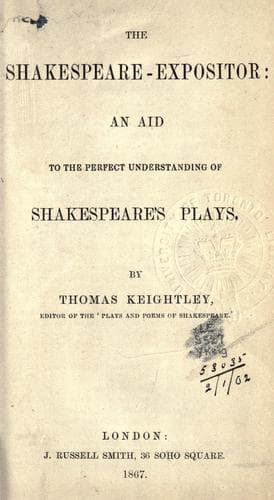
The Shakespeare-Expositor: An Aid to the Perfect Understanding of Shakespeare's PlaysKeightley, Thomas
General
The Shakespeare-Expositor: An Aid to the Perfect Understanding of Shakespeare's Plays
Keightley, Thomas
Drama -- Outlines, syllabi, etc.; Shakespeare, William, 1564-1616 -- Outlines, syllabi, etc.
Theobald proposed and then rejected 'winter-_cheer_.' I should prefer
_summer_ for 'winter' (see Introd. p. 66); for in Dr. Forman's Diary of
the year 1594--which year Shakespeare had certainly in view--we read,
"This monethes of June and July were very wet and wonderfull cold,
like winter, that the 10 dae of Julii many did syt by the fyer, yt
was so cold; and soe was it in Maye and June; and scarse too fair dais
together all that tyme, but it rayned every day more or lesse. Yf it
did not raine then was it cold and cloudye.... There were many gret
fludes this sommer."
"The seasons change their manners, as the year
Had found some months asleep and leaped them over."
2 Hen. IV. iv. 4.
It is possible, however, that the error may lie in 'want,' for which we
might read _have_, or some other word.
* * * * *
"And on old Hiems' chin and icy crown
An odorous chaplet."
For 'chin' Grey read _chill_; Tyrwhitt, whom some follow, _thin_. But
it is probably one of those inadvertencies so frequent in our poet.
* * * * *
"The one I'll slay, the other slayeth me."
Thirlby's just correction of _stay_ and _stayeth_.
* * * * *
"Hast thou the flower there? Welcome, wanderer.--
Ay, there it is.--I pray thee give it me."
For 'there' in the second line, Mr. Dyce reads--and perhaps
rightly--_here_.
* * * * *
"I know a bank," etc.
I read and arrange the whole passage thus:
"I know a bank whëre the wild thyme blows,
Where violets and the nodding oxlip grows,
Quite o'er-canopied with lusciöus woodbine,
With sweet musk-roses and with eglantine,
And there the snake throws her enamell'd skin
Weed wide enough to wrap a fairy in.
There sleeps Titania sometime of the night,
Lull'd in these flowers with dances and delight.
Then with the juice of this I'll streak her eyes," etc.
In the second line I have transposed 'oxlip' and 'violet'; for the
former 'nods' and the latter does not, "With cowslips wan, that hang
the pensive head" (Lycidas, _v._ 14). In the third I give _o'er_ for
'over.' The transposition which follows is imperatively demanded by
the sequence of ideas, and we have other instances in this play. The
fifth and sixth lines may have been an addition made by the poet or
transcriber in the margin, and taken in in the wrong place by the
printer. (See on i. 1.) If 'And' be the right word in the last line,
something must have been lost, _ex. gr._ "Upon her will I steal there
as she lies;" but the poet's word may have been what I have given,
_Then_, strongly emphaticized, and written _Than_, the two first
letters of which having been effaced, the printer made it 'And.' The
very same thing seems to have taken place in L. L. L. v. 2. It may also
have been that _y_^{n}, then, was taken for &, and.
Public-domain text, read in full here on John Shaqi.
Reviews
Reviews
No reviews yet
Be the first to share your thoughts on this work.
Elsewhere in the archive
Join the Discussion
Join the discussion
Sign in to leave a comment or review.
Sign InorCreate an account