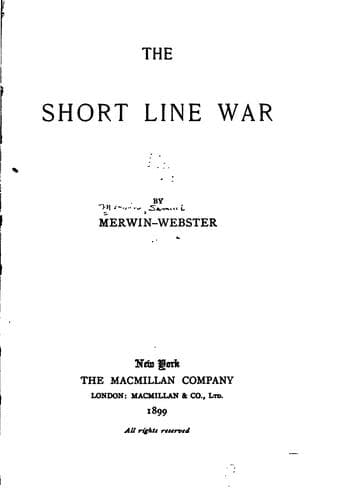
Historical fiction; Railroads -- History -- Fiction
But the conference, which any reporter in Chicago would have given his
ears to hear, was a quiet one. The Governor dominated the situation,
and at the very outset he made this clear. In his dealings with the
Intelligent Voter he was wont to call a spade by many high-sounding
names, but when he chose he could call it a spade, and he did choose so
to do this afternoon.
The road, he said, was for the present in the hands of the State. Every
station was guarded by a detail of State troops who had instructions
to pay no attention to any writs from any court whatever. In every case
they were to respect actual possession, and to allow the routine work of
running the road to be carried on by the men they found in charge. This
state of things would continue until the Governor was fully convinced
that there would be no further attempt by either party to obtain
possession of the road by force.
The Governor went on to point out that a continuation of this
arrangement was against the interest of both parties, as it brought the
affairs of the road into unpleasant prominence, and every added day of
it antagonized the people more, and might eventually lead to some rather
drastic legislation which would hurt every road in the State.
The courts would of course settle the question of possession in time,
but meanwhile some sort of an understanding must be reached. The
Governor proposed as a solution of the difficulty that the two men
should jointly sign a paper he had drawn up.
It was a petition addressed to the Governor himself, asking him to
appoint one or more men to act as receivers of the road until the suits
should be settled by the regular process of law. The men to be appointed
were to be allies of neither party in the fight. Both parties agreed to
refrain from any further attempts to use force in getting possession of
the road.
Weeks readily, and Porter after a moment of hesitation, signed the
paper, and the Governor announced that his appointment would be made
immediately.
It was then arranged that the regular annual election of directors,
which was due on the following Tuesday, should be held as usual. After
the legal questions were settled, the Governor's commission would turn
over the road to the newly elected board.
When the conference was over, and it had not been a long one, the two
warring railway magnates, who in the past week had set the whole State
by the ears, rose and politely took their leave. As they went down in
the elevator together, Weeks remarked,--
“Autumn seems to have taken hold early this year.”
“Yes,” answered Porter, “it's extremely disagreeable weather. I have my
carriage here. May I save you a walk?”
“No, thanks,” said Jim; “I'm not going far.”
When they parted at the door they did not shake hands, but there was
nothing in their manner to indicate that they had not just met for the
first time at an afternoon tea.
Public-domain text, read in full here on John Shaqi.
Reviews
Reviews
No reviews yet
Be the first to share your thoughts on this work.
Elsewhere in the archive
Join the Discussion
Join the discussion
Sign in to leave a comment or review.
Sign InorCreate an account