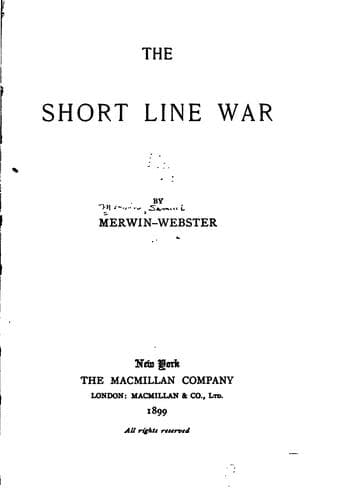
Historical fiction; Railroads -- History -- Fiction
“There's something beside scarlet fever that keeps up that delirium, I
believe; something on his mind. I'd watch what he says pretty carefully,
if I were you. He may give you a clew to what's bothering him. Then
perhaps we can bring him around. Good night.”
Grace Burns was not in the habit of reading the papers, for her
activities, her sympathies, and her thoughts were pretty well absorbed
without them, but on Thursday morning she read with eager interest
the account of the fight for the M. & T. railroad. She also read an
editorial on Jim Weeks, and then found out all she could from the
newspapers of the two days previous. When she had finished, she
abandoned a half-formed project of the night before to write to
Weeks and explain the situation to him on the chance of his being
of assistance. She saw on what a large scale this man did things and
concluded that it was unlikely that he had any connection with Bridge's
affairs, if, indeed, he had ever heard of him. He would be too busy to
pay much attention to anything she might write.
All day long she listened to the sick man's continuous talk, hoping that
some meaning would transpire through the incoherent sentences, something
that would guide her to the source of his trouble; but her patience had
little reward. He spoke vaguely of a contract once or twice, and as many
times he mentioned the name of Jim Weeks, and at those times she thought
of her plan again; mentally she would begin framing the note she would
write to the great capitalist. But as often as she did this she realized
that she had nothing to say to him, and with a sigh she put the thought
away to wait at least until she could find out something more definite.
The next morning, Friday, she read in the papers of the dramatic
happenings of the day before and of Jim Weeks's going to Chicago,
presumably for a conference with the Governor. The bigness of it
appalled her a little, and again the courage she had been storing up
over night to write the note oozed away. For after all it was a question
of courage, courage to do something which common sense called absurd on
the bare chance that it might do good.
The day was a repetition of the day before, but late in the afternoon
the persistent thought, “it might do some good,” drove her to write to
Jim Weeks. The note read:--
“Mr. Bridge [she did not know his initials] is dangerously sick here in
the hospital. He has been delirious ever since he was brought here, and
has frequently called for you, sometimes as if he wanted to tell you
something, and at others as if he desired your protection. I write in
the hope that you will be able either to come or to suggest some clew to
his delusions which may enable us to remove them.”
It was mailed that evening and reached Jim about noon Saturday. Not
half an hour afterward she received a telegram which took a load off her
mind:--
Public-domain text, read in full here on John Shaqi.
Reviews
Reviews
No reviews yet
Be the first to share your thoughts on this work.
Elsewhere in the archive
Join the Discussion
Join the discussion
Sign in to leave a comment or review.
Sign InorCreate an account