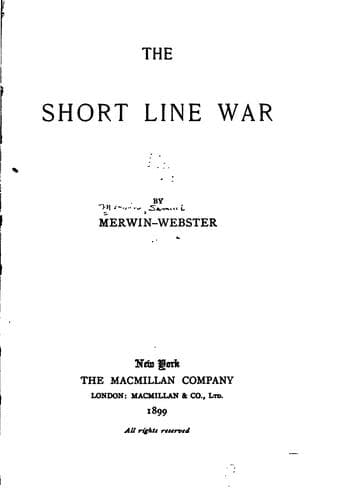
Historical fiction; Railroads -- History -- Fiction
He did not hear of Jim's arrival in town and his drive to the hospital
until next morning. When told of it, he laid down his pipe and began
slipping on his coat.
“I suppose he's in town yet,” he said to the reporter who had brought
the news. “If he is, I'm going to see him; then I can make something out
of what he might have said. He's the kind that makes me mad. He's got
as good a story inside him as any man in the United States this morning,
but it would take a chemical process to get it out of him.”
Jim was in his room at the Hotel Tremain, trying to decide upon the best
way to bring Blaney to terms. The most direct course would be to go
to Blaney and try to convince him of the worthlessness of McNally's
contract. Blaney was badly scared already: that was evident enough in
his manner during the interview Jim had had with him on the artesian
road. The two weeks of suspense, during which time it was clear that Jim
was winning, would not tend to increase Blaney's confidence. It would
not take much of a bluff to complete his demoralization.
But the difficulty lay in the manner of approach. To make the bluff most
effective, Blaney should be frightened into seeking Jim. If he went to
Blaney's house, the contractor would probably suspect that some weakness
in Jim's position made him depend on Blaney's aid. Jim was not worrying
over the problem as other men worry, for he had been quite sincere
in telling Bridge that they were sure to win. Years of this kind of
fighting had given him a just estimate of the immense value of time,
and he had forty-eight hours left in which to get control of the Tillman
City stock. Campaigns have been lost and won again in less time than
that.
When the bell-boy brought up the editor's card Jim stared at it a
moment, then told the boy to show him in. Had the boy looked up he would
have seen that Jim was smiling. His plan had come to him.
When the editor came into the room he found Jim lounging in a big chair
with his feet on another, bent apparently on spending the morning in
luxurious idleness. Jim did not rise but greeted him cheerfully, and the
editor took the chair Jim nodded to and accepted the cigar Jim offered
him. This was the beginning of what the editor afterward spoke of as his
trance.
For there sat Jim Weeks, the wary, the close-mouthed, the reporter's
despair, artlessly telling the whole inside history of the fight for the
M. & T. At first the editor hardly dared to breathe for fear of bringing
Jim to his senses and the story to a premature conclusion; but as the
President talked apparently in his right mind, the editor became bolder
and began asking questions. In answering, Jim told him that the fight
was practically over. It would formally be decided on Tuesday at the
stockholders' meeting; but as Jim and his allies controlled a majority
of the stock, the outcome was certain.
Public-domain text, read in full here on John Shaqi.
Reviews
Reviews
No reviews yet
Be the first to share your thoughts on this work.
Elsewhere in the archive
Join the Discussion
Join the discussion
Sign in to leave a comment or review.
Sign InorCreate an account