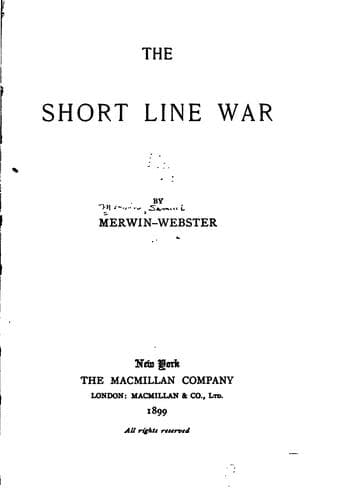
Historical fiction; Railroads -- History -- Fiction
Porter took a chair and looked out of the window. For a moment he was
too weary to be aggressive. Worry and loss of sleep had lined his face,
and the absence of news from McNally kept his nerves strung. As he
sat there gripping the arms of the chair, face a little flushed, hair
disarranged, collar dusty, he looked ten years past his age. It was a
critical moment in the fight, and he knew it, but cornered as he was,
absolutely uninformed as to his position in the struggle, or the meaning
of the military display, a sense of helplessness almost unnerved him.
Heretofore his fights had been largely conducted through deferential
employees. He was accustomed to bows and scrapes, to men who feared him,
who watched his every move in awe, and to find himself utterly at the
mercy of these tin soldiers was disgusting. It was twenty-four hours
since he had had a wink of sleep and eighteen since he had eaten a full
meal--facts which in no small measure lessened the stability of his
mental poise. And there he sat waiting through the darkness and the
dawn.
The reds and golds in the eastern sky spread and paled. The little
green-clad city stretched down the gentle hill, now indistinct in the
haze. An early electric car whirred and jangled past the station, and
Porter was half conscious of the noise. He got up, straightened his
stiff joints, and went to the lunch counter, where he had to jostle
between two gawky privates before he could order a cup of smoky cereal
coffee and a sandwich. After getting a place he could not eat, so he
returned to the office. Now that some sort of routine was established,
the Captain showed a willingness to meet him civilly.
“See here,” said Porter, after a few commonplaces had been exchanged,
“how long is this going to keep up? There is no sense in holding me
here.”
“Sorry, sir. I have no desire to inconvenience you, but my orders are to
let no one out and no one in. And you know what orders are for.”
“Oh, that's all right,”--Porter leaned back in his chair and looked out
the window,--“but there's such a thing as going to extremes. Sometimes
common sense supersedes orders.”
“You forget, Mr. Porter, that you are here for the purpose of conducting
a raid, and we are here to stop that raid. Under the circumstances it is
my duty to hold you and every one connected with the affair until I am
otherwise ordered.”
“But I am not a thief, man.”
“No, perhaps not.” The Captain turned to some papers on the desk, and
Porter continued to look out, wearily, with a sudden dull ache above his
eyes.
A corporal appeared in the doorway, saluting.
“There's a young lady, sir, says she's got to see Mr. Porter.”
“Who is she?”
“Don't know, but she sticks to it.”
“It's my daughter,” said Porter, with an effort to rise. “Where is she?”
“Wait,” the Captain said; “I'll speak to her,” and he followed the
soldier.
Public-domain text, read in full here on John Shaqi.
Reviews
Reviews
No reviews yet
Be the first to share your thoughts on this work.
Elsewhere in the archive
Join the Discussion
Join the discussion
Sign in to leave a comment or review.
Sign InorCreate an account