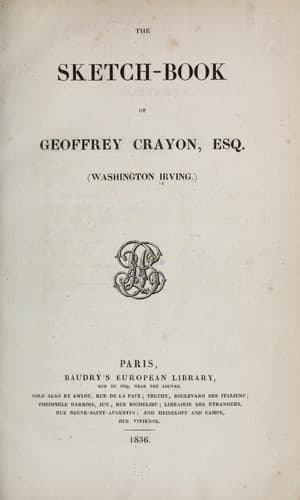
The Sketch-Book of Geoffrey CrayonIrving, Washington
History
The Sketch-Book of Geoffrey Crayon
Irving, Washington
Americans -- England -- History -- 19th century; Catskill Mountains Region (N.Y.) -- Fiction; England -- Social life and customs -- 19th century; Fantasy fiction, American; Hudson River Valley (N.Y. and N.J.) -- Fiction; Irving, Washington, 1783-1859 -- Travel -- England
It would be trite to dwell on the particulars of her after story. It
was, like other tales of love, melancholy. She avoided society and
wandered out alone in the walks she had most frequented with her lover.
She sought, like the stricken deer, to weep in silence and loneliness
and brood over the barbed sorrow that rankled in her soul. Sometimes
she would be seen late of an evening sitting in the porch of the village
church, and the milk-maids, returning from the fields, would now and
then overhear her singing some plaintive ditty in the hawthorn walk. She
became fervent in her devotions at church, and as the old people saw her
approach, so wasted away, yet with a hectic gloom and that hallowed air
which melancholy diffuses round the form, they would make way for her as
for something spiritual, and looking after her, would shake their heads
in gloomy foreboding.
She felt a conviction that she was hastening to the tomb, but looked
forward to it as a place of rest. The silver cord that had bound her to
existence was loosed, and there seemed to be no more pleasure under the
sun. If ever her gentle bosom had entertained resentment against her
lover, it was extinguished. She was incapable of angry passions, and in
a moment of saddened tenderness she penned him a farewell letter. It was
couched in the simplest language, but touching from its very simplicity.
She told him that she was dying, and did not conceal from him that his
conduct was the cause. She even depicted the sufferings which she had
experienced, but concluded with saying that she could not die in peace
until she had sent him her forgiveness and her blessing.
By degrees her strength declined that she could no longer leave the
cottage. She could only totter to the window, where, propped up in
her chair, it was her enjoyment to sit all day and look out upon the
landscape. Still she uttered no complaint nor imparted to any one the
malady that was preying on her heart. She never even mentioned her
lover’s name, but would lay her head on her mother’s bosom and weep in
silence. Her poor parents hung in mute anxiety over this fading blossom
of their hopes, still flattering themselves that it might again revive
to freshness and that the bright unearthly bloom which sometimes flushed
her cheek might be the promise of returning health.
In this way she was seated between them one Sunday afternoon; her hands
were clasped in theirs, the lattice was thrown open, and the soft
air that stole in brought with it the fragrance of the clustering
honeysuckle which her own hands had trained round the window.
Public-domain text, read in full here on John Shaqi.
Reviews
Reviews
No reviews yet
Be the first to share your thoughts on this work.
Elsewhere in the archive
Join the Discussion
Join the discussion
Sign in to leave a comment or review.
Sign InorCreate an account