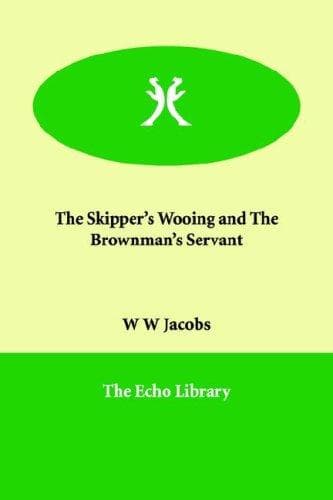
The skipper's wooing, and The brown man's servantJacobs, W. W. (William Wymark)
General
The skipper's wooing, and The brown man's servant
Jacobs, W. W. (William Wymark)
Sailors -- Fiction
The pawnbroker pricked up his ears. “Nonsense,” he said, with an
attempt at heartiness, “a jolly fellow like you don’t want tea. Have
some o’ this.”
“Tea, confound yer!” said the other. “When I say tea, I mean tea.”
The pawnbroker, repressing his choler, replaced the bottle, and,
seating himself at the table, reached over for the kettle, and made the
tea. It was really a pleasing picture of domestic life, and would have
looked well in a lantern slide at a temperance lecture, the long, gaunt
Jew and the burly seaman hobnobbing over the blameless teapot. But Mr.
Hyams grew restless. He was intent upon business; but the other, so far
as his inroads on the teapot and the eatables gave any indication,
seemed to be bent only upon pleasure. Once again the picture of the
former sailor rose before Mr. Hyams’ eyes, and he scowled fiercely as
the seaman pushed his cup up for the fourth time.
“And now for a smoke,” said his visitor, as he settled back in his
chair. “A good ’un, mind. Lord, this is comfort! It’s the first bit o’
comfort I’ve ’ad since I come ashore five days ago.”
The pawnbroker grunted, and producing a couple of black, greasy-looking
cigars, gave one to his guest. They both fell to smoking, the former
ill at ease, the latter with his feet spread out on the small fender,
making the very utmost of his bit of comfort.
“Are you a man as is fond of asking questions?” he said at length.
“No,” said the pawnbroker, shutting his lips illustratively.
“Suppose,” said the sailor, leaning forward intently—“suppose a man
came to you an’ ses— there’s that confounded assistant of yours peeping
through the door.”
The pawnbroker got up almost as exasperated as the seaman, and, after
rating his assistant through the half-open door, closed it with a bang,
and pulled down a small blind over the glass.
“Suppose a man came to you,” resumed the sailor, after the pawnbroker
had seated himself again, “and asked you for five hundred pounds for
something. Have you got it?”
“Not here,” said the pawnbroker suspiciously. “I don’t keep any money
on the premises.”
“You could get it, though?” suggested the other.
“We’ll see,” said the pawnbroker; “five hundred pounds is a
fortune—five hundred pounds, why it takes years of work—five hundred
pounds—”
“I don’t want no blessed psalms,” said the seaman abruptly; “but, look
here, suppose I wanted five hundred pounds for something, and you
wouldn’t give it. How am I to know you wouldn’t give information to the
police if I didn’t take what you offered me for it?”
The pawnbroker threw up his huge palms in virtuous horror.
“I’d mark you for it if you did,” said the seaman menacingly, through
his teeth. “It ’ud be the worst day’s work you ever did. Will you take
it or leave it at my price, an’ if you won’t give it, leave me to go as
I came?”
“I will,” said the pawnbroker solemnly.
Public-domain text, read in full here on John Shaqi.
Reviews
Reviews
No reviews yet
Be the first to share your thoughts on this work.
Elsewhere in the archive
Join the Discussion
Join the discussion
Sign in to leave a comment or review.
Sign InorCreate an account