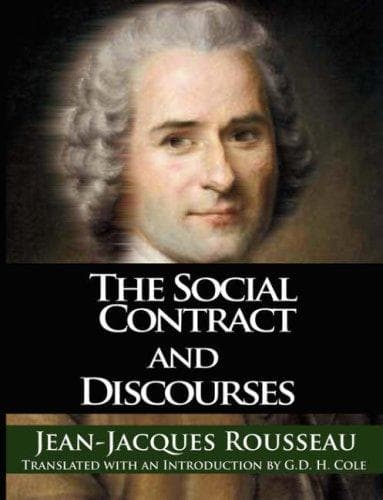
The social contract & discoursesRousseau, Jean-Jacques
Philosophy
The social contract & discourses
Rousseau, Jean-Jacques
Economics; Political science -- Early works to 1800; Social contract
It is not enough for the assembled people to have once fixed the
constitution of the State by giving its sanction to a body of law;
it is not enough for it to have set up a perpetual government, or
provided once for all for the election of magistrates. Besides the
extraordinary assemblies unforeseen circumstances may demand, there
must be fixed periodical assemblies which cannot be abrogated or
prorogued, so that on the proper day the people is legitimately called
together by law, without need of any formal summoning.
But, apart from these assemblies authorised by their date alone, every
assembly of the people not summoned by the magistrates appointed for
that purpose, and in accordance with the prescribed forms, should be
regarded as unlawful, and all its acts as null and void, because the
command to assemble should itself proceed from the law.
The greater or less frequency with which lawful assemblies should occur
depends on so many considerations that no exact rules about them can be
given. It can only be said generally that the stronger the government
the more often should the Sovereign show itself.
This, I shall be told, may do for a single town; but what is to be
done when the State includes several? Is the sovereign authority to be
divided? Or is it to be concentrated in a single town to which all the
rest are made subject?
Neither the one nor the other, I reply. First, the sovereign authority
is one and simple, and cannot be divided without being destroyed. In th
second place, one town cannot, any more than one nation, legitimately
be made subject to another, because the essence of the body politic
lies in the reconciliation of obedience and liberty, and the words
subject and Sovereign are identical correlatives the idea of which
meets in the single word "citizen."
I answer further that the union of several towns in a single city is
always bad, and that, if we wish to make such a union, we should not
expect to avoid its natural disadvantages. It is useless to bring up
abuses that belong to great States against one who desires to see only
small ones; but how can small States be given the strength to resist
great ones, as formerly the Greek towns resisted the Great King, and
more recently Holland and Switzerland have resisted the House of
Austria?
Nevertheless, if the State cannot be reduced to the right limits, there
remains still one resource; this is, to allow no capital, to make the
seat of government move from town to town, and to assemble by turn in
each the Provincial Estates of the country.
People the territory evenly, extend everywhere the same rights, bear
to every place in it abundance and life: by these means will the State
become at once as strong and as well governed as possible. Remember
that the walls of towns are built of the ruins of the houses of the
countryside. For every palace I see raised in the capital, my mind's
eye sees a whole country made desolate.
CHAPTER XIV
THE SAME (continued)
Public-domain text, read in full here on John Shaqi.
Reviews
Reviews
No reviews yet
Be the first to share your thoughts on this work.
Elsewhere in the archive
Join the Discussion
Join the discussion
Sign in to leave a comment or review.
Sign InorCreate an account