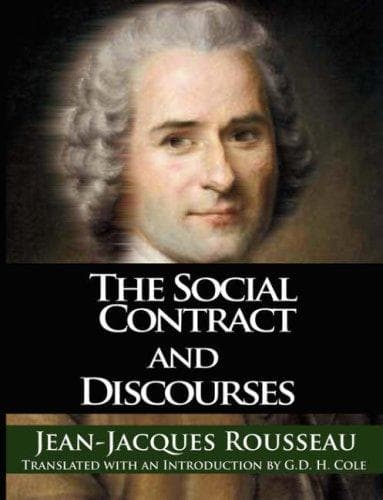
The social contract & discoursesRousseau, Jean-Jacques
Philosophy
The social contract & discourses
Rousseau, Jean-Jacques
Economics; Political science -- Early works to 1800; Social contract
Election by lot would have few disadvantages in a real democracy, in
which, as equality would everywhere exist in morals and talents as
well as in principles and fortunes, it would become almost a matter
of indifference who was chosen. But I have already said that a real
democracy is only an ideal.
When choice and lot are combined, positions that require special
talents, such as military posts, should be filled by the former; the
latter does for cases, such as judicial offices, in which good sense,
justice, and integrity are enough, because in a State that is well
constituted, these qualities are common to all the citizens.
Neither lot nor vote has any place in monarchical government. The
monarch being by right sole prince and only magistrate, the choice of
his lieutenants belongs to none but him. When the Abbé de Saint-Pierre
proposed that the Councils of the King of France should be multiplied,
and their members elected by ballot, he did not see that he was
proposing to change the form of government.
I should now speak of the methods of giving and counting opinions in
the assembly of the people; but perhaps an account of this aspect of
the Roman constitution will more forcibly illustrate all the rules I
could lay down. It is worth the while of a judicious reader to follow
in some detail the working of public and private affairs in a Council
consisting of two hundred thousand men.
CHAPTER IV
THE ROMAN COMITIA
We are without well-certified records of the first period of Rome's
existence; it even appears very probable that most of the stories told
about it are fables; indeed, generally speaking, the most instructive
part of the history of peoples, that which deals with their foundation,
is what we have least of. Experience teaches us every day what causes
lead to the revolutions of empires; but, as no new peoples are now
formed, we have almost nothing beyond conjecture to go upon in
explaining how they were created.
The customs we find established show at least that these customs had
an origin. The traditions that go back to those origins, that have
the greatest authorities behind them, and that are confirmed by the
strongest proofs, should pass for the most certain. These are the rules
I have tried to follow in inquiring how the freest and most powerful
people on earth exercised its supreme power.
After the foundation of Rome, the new-born republic, that is, the
army of its founder, composed of Albans, Sabines and foreigners, was
divided into three classes, which, from this division, took the name
of _tribes_. Each of these tribes was subdivided into ten _curiæ_, and
each _curia_ into _decuriæ_, headed by leaders called _curiones_ and
_decuriones_.
Public-domain text, read in full here on John Shaqi.
Reviews
Reviews
No reviews yet
Be the first to share your thoughts on this work.
Elsewhere in the archive
Join the Discussion
Join the discussion
Sign in to leave a comment or review.
Sign InorCreate an account