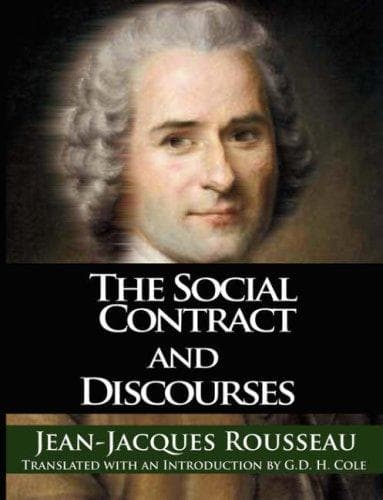
The social contract & discoursesRousseau, Jean-Jacques
Philosophy
The social contract & discourses
Rousseau, Jean-Jacques
Economics; Political science -- Early works to 1800; Social contract
Towards the end of the Republic, the Romans, having grown more
circumspect, were as unreasonably sparing in the use of the
dictatorship as they had formerly been lavish. It is easy to see
that their fears were without foundation, that the weakness of the
capital secured it against the magistrates who were in its midst; that
a dictator might, in certain cases, defend the public liberty, but
could never endanger it; and that the chains of Rome would be forged,
not in Rome itself, but in her armies. The weak resistance offered by
Marius to Sulla, and by Pompey to Cæsar, clearly showed what was to be
expected from authority at home against force from abroad.
This misconception led the Romans to make great mistakes; such, for
example, as the failure to nominate a dictator in the Catilinarian
conspiracy. For, as only the city itself, with at most some province
in Italy, was concerned, the unlimited authority the laws gave to the
dictator would have enabled him to make short work of the conspiracy,
which was, in fact, stifled only by a combination of lucky chances
human prudence had no right to expect.
Instead, the senate contented itself with entrusting its whole power
to the consuls, so that Cicero, in order to take effective action, was
compelled on a capital point to exceed his powers; and if, in the first
transports of joy, his conduct was approved, he was justly called,
later on, to account for the blood of citizens spilt in violation of
the laws. Such a reproach could never have been levelled at a dictator.
But the consul's eloquence carried the day; and he himself, Roman
though he was, loved his own glory better than his country, and sought,
not so much the most lawful and secure means of saving the State, as to
get for himself the whole honour of having done so.[2] He was therefore
justly honoured as the liberator of Rome, and also justly punished
as a law-breaker. However brilliant his recall may have been, it was
undoubtedly an act of pardon.
However this important trust be conferred, it is important that its
duration should be fixed at a very brief period, incapable of being
ever prolonged. In the crises which lead to its adoption, the State
is either soon lost, or soon saved; and, the present need passed,
the dictatorship becomes either tyrannical or idle. At Rome, where
dictators held office for six months only, most of them abdicated
before their time was up. If their term had been longer, they might
well have tried to prolong it still further, as the decemvirs did when
chosen for a year. The dictator had only time to provide against the
need that had caused him to be chosen; he had none to think of further
projects.
[1] The nomination was made secretly by night, as if there were
something shameful in setting a man above the laws.
[2] That is what he could not be sure of, if he proposed a dictator;
for he dared not nominate himself, and could not be certain that his
colleague would nominate him.
CHAPTER VII
THE CENSORSHIP
Public-domain text, read in full here on John Shaqi.
Reviews
Reviews
No reviews yet
Be the first to share your thoughts on this work.
Elsewhere in the archive
Join the Discussion
Join the discussion
Sign in to leave a comment or review.
Sign InorCreate an account