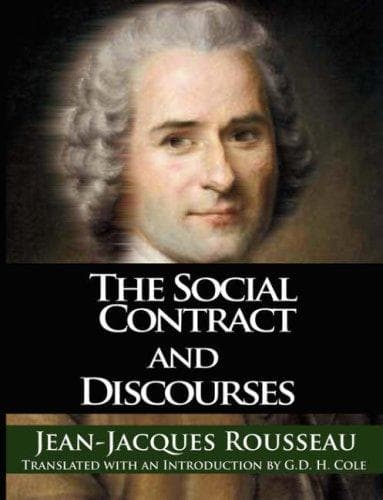
The social contract & discoursesRousseau, Jean-Jacques
Philosophy
The social contract & discourses
Rousseau, Jean-Jacques
Economics; Political science -- Early works to 1800; Social contract
MOST HONOURABLE, MAGNIFICENT AND SOVEREIGN LORDS, convinced that
only a virtuous citizen can confer on his country honours which it
can accept, I have been for thirty years past working to make myself
worthy to offer you some public homage; and, this fortunate opportunity
supplementing in some degree the insufficiency of my efforts, I have
thought myself entitled to follow in embracing it the dictates of the
zeal which inspires me, rather than the right which should have been my
authorisation. Having had the happiness to be born among you, how could
I reflect on the equality which nature has ordained between men, and
the inequality which they have introduced, without reflecting on the
profound wisdom by which both are in this State happily combined and
made to coincide, in the manner that is most in conformity with natural
law, and most favourable to society, to the maintenance of public order
and to the happiness of individuals? In my researches after the best
rules common sense can lay down for the constitution of a government,
I have been so struck at finding them all in actuality in your own,
that even had I not been born within your walls I should have thought
it indispensable for me to offer this picture of human society to that
people, which of all others seems to be possessed of its greatest
advantages, and to have best guarded against its abuses.
If I had had to make choice of the place of my birth, I should have
preferred a society which had an extent proportionate to the limits
of the human faculties; that is, to the possibility of being well
governed: in which every person being equal to his occupation, no one
should be obliged to commit to others the functions with which he was
entrusted: a State, in which all the individuals being well known to
one another, neither the secret machinations of vice, nor the modesty
of virtue should be able to escape the notice and judgment of the
public; and in which the pleasant custom of seeing and knowing one
another should make the love of country rather a love of the citizens
than of its soil.
I should have wished to be born in a country in which the interest of
the Sovereign and that of the people must be single and identical; to
the end that all the movements of the machine might tend always to
the general happiness. And as this could not be the case, unless the
Sovereign and the people were one and the same person, it follows that
I should have wished to be born under a democratic government, wisely
tempered.
I should have wished to live and die free: that is, so far subject to
the laws that neither I, nor anybody else, should be able to cast off
their honourable yoke: the easy and salutary yoke which the haughtiest
necks bear with the greater docility, as they are made to bear no other.
Public-domain text, read in full here on John Shaqi.
Reviews
Reviews
No reviews yet
Be the first to share your thoughts on this work.
Elsewhere in the archive
Join the Discussion
Join the discussion
Sign in to leave a comment or review.
Sign InorCreate an account