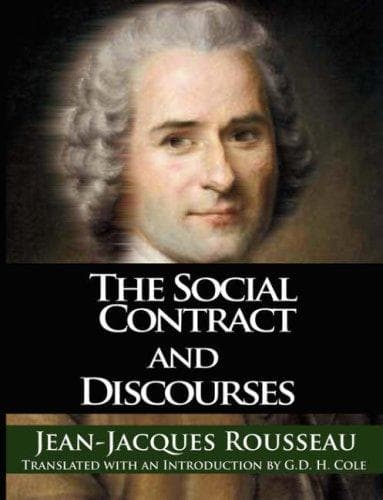
The social contract & discoursesRousseau, Jean-Jacques
Philosophy
The social contract & discourses
Rousseau, Jean-Jacques
Economics; Political science -- Early works to 1800; Social contract
I should have wished to choose myself a country, diverted, by a
fortunate impotence, from the brutal love of conquest, and secured, by
a still more fortunate situation, from the fear of becoming itself the
conquest of other States: a free city situated between several nations,
none of which should have any interest in attacking it, while each
had an interest in preventing it from being attacked by the others;
in short, a Republic which should have nothing to tempt the ambition
of its neighbours, but might reasonably depend on their assistance in
case of need. It follows that a republican State so happily situated
could have nothing to fear but from itself; and that, if its members
trained themselves to the use of arms, it would be rather to keep alive
that military ardour and courageous spirit which are so proper among
free-men, and tend to keep up their taste for liberty, than from the
necessity of providing for their defence.
I should have sought a country, in which the right of legislation
was vested in all the citizens; for who can judge better than they of
the conditions under which they had best dwell together in the same
society? Not that I should have approved of Plebiscita, like those
among the Romans; in which the rulers in the State, and those most
interested in its preservation, were excluded from the deliberations on
which in many cases its security depended; and in which, by the most
absurd inconsistency, the magistrates were deprived of rights which the
meanest citizens enjoyed.
On the contrary, I should have desired that, in order to prevent
self-interested and ill-conceived projects, and all such dangerous
innovations as finally ruined the Athenians, each man should not be at
liberty to propose new laws at pleasure; but that this right should
belong exclusively to the magistrates; and that even they should use it
with so much caution, the people, on its side, be so reserved in giving
its consent to such laws, and the promulgation of them be attended
with so much solemnity, that before the constitution could be upset by
them, there might be time enough for all to be convinced, that it is
above all the great antiquity of the laws which makes them sacred and
venerable, that men soon learn to despise laws which they see daily
altered, and that States, by accustoming themselves to neglect their
ancient customs under the pretext of improvement, often introduce
greater evils than those they endeavour to remove.
Public-domain text, read in full here on John Shaqi.
Reviews
Reviews
No reviews yet
Be the first to share your thoughts on this work.
Elsewhere in the archive
Join the Discussion
Join the discussion
Sign in to leave a comment or review.
Sign InorCreate an account