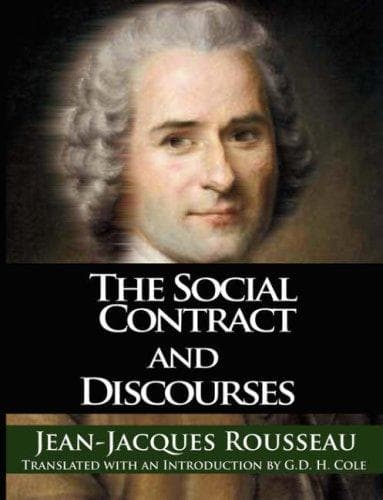
The social contract & discoursesRousseau, Jean-Jacques
Philosophy
The social contract & discourses
Rousseau, Jean-Jacques
Economics; Political science -- Early works to 1800; Social contract
I see nothing in any animal but an ingenious machine, to which nature
hath given senses to wind itself up, and to guard itself, to a certain
degree, against anything that might tend to disorder or destroy it.
I perceive exactly the same things in the human machine, with this
difference, that in the operations of the brute, nature is the sole
agent, whereas man has some share in his own operations, in his
character as a free agent. The one chooses and refuses by instinct, the
other from an act of free-will: hence the brute cannot deviate from the
rule prescribed to it, even when it would be advantageous for it to do
so; and, on the contrary, man frequently deviates from such rules to
his own prejudice. Thus a pigeon would be starved to death by the side
of a dish of the choicest meats, and a cat on a heap of fruit or grain;
though it is certain that either might find nourishment in the foods
which it thus rejects with disdain, did it think of trying them. Hence
it is that dissolute men run into excesses which bring on fevers and
death; because the mind depraves the senses, and the will continues to
speak when nature is silent.
Every animal has ideas, since it has senses; it even combines those
ideas in a certain degree; and it is only in degree that man differs,
in this respect, from the brute. Some philosophers have even maintained
that there is a greater difference between one man and another than
between some men and some beasts. It is not, therefore, so much the
understanding that constitutes the specific difference between the man
and the brute, as the human quality of free-agency. Nature lays her
commands on every animal, and the brute obeys her voice. Man receives
the same impulsion, but at the same time knows himself at liberty
to acquiesce or resist: and it is particularly in his consciousness
of this liberty that the spirituality of his soul is displayed. For
physics may explain, in some measure, the mechanism of the senses
and the formation of ideas; but in the power of willing or rather of
choosing, and in the feeling of this power, nothing is to be found but
acts which are purely spiritual and wholly inexplicable by the laws of
mechanism.
Public-domain text, read in full here on John Shaqi.
Reviews
Reviews
No reviews yet
Be the first to share your thoughts on this work.
Elsewhere in the archive
Join the Discussion
Join the discussion
Sign in to leave a comment or review.
Sign InorCreate an account