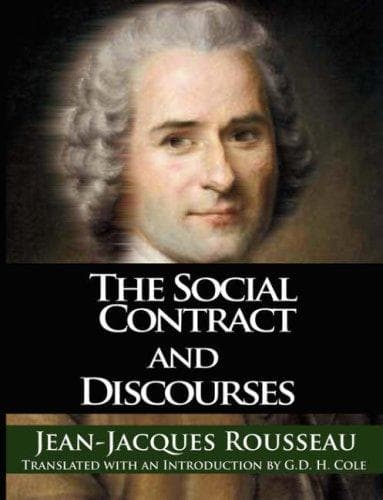
The social contract & discoursesRousseau, Jean-Jacques
Philosophy
The social contract & discourses
Rousseau, Jean-Jacques
Economics; Political science -- Early works to 1800; Social contract
The first language of mankind, the most universal and vivid, in a
word the only language man needed, before he had occasion to exert
his eloquence to persuade assembled multitudes, was the simple cry of
nature. But as this was excited only by a sort of instinct on urgent
occasions, to implore assistance in case of danger, or relief in case
of suffering, it could be of little use in the ordinary course of life,
in which more moderate feelings prevail. When the ideas of men began to
expand and multiply, and closer communication took place among them,
they strove to invent more numerous signs and a more copious language.
They multiplied the inflections of the voice, and added gestures,
which are in their own nature more expressive, and depend less for
their meaning on a prior determination. Visible and movable objects
were therefore expressed by gestures, and audible ones by imitative
sounds: but, as hardly anything can be indicated by gestures, except
objects actually present or easily described, and visible actions; as
they are not universally useful--for darkness or the interposition
of a material object destroys their efficacy--and as besides they
rather request than secure our attention; men at length bethought
themselves of substituting for them the articulate sounds of the voice,
which, without bearing the same relation to any particular ideas, are
better calculated to express them all, as conventional signs. Such an
institution could only be made by common consent, and must have been
effected in a manner not very easy for men whose gross organs had not
been accustomed to any such exercise. It is also in itself still more
difficult to conceive, since such a common agreement must have had
motives, and speech seems to have been highly necessary to establish
the use of it.
It is reasonable to suppose that the words first made use of by mankind
had a much more extensive signification than those used in languages
already formed, and that ignorant as they were of the division of
discourse into its constituent parts, they at first gave every single
word the sense of a whole proposition. When they began to distinguish
subject and attribute, and noun and verb, which was itself no common
effort of genius, substantives were at first only so many proper
names; the present infinitive was the only tense of verbs; and the very
idea of adjectives must have been developed with great difficulty; for
every adjective is an abstract idea, and abstractions are painful and
unnatural operations.
Public-domain text, read in full here on John Shaqi.
Reviews
Reviews
No reviews yet
Be the first to share your thoughts on this work.
Elsewhere in the archive
Join the Discussion
Join the discussion
Sign in to leave a comment or review.
Sign InorCreate an account