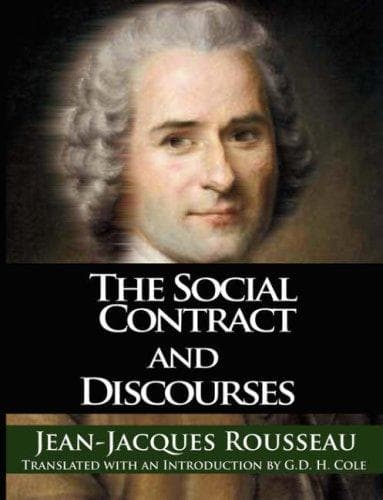
The social contract & discoursesRousseau, Jean-Jacques
Philosophy
The social contract & discourses
Rousseau, Jean-Jacques
Economics; Political science -- Early works to 1800; Social contract
But when our new grammarians, by means of which I have no conception,
began to extend their ideas and generalise their terms, the ignorance
of the inventors must have confined this method within very narrow
limits; and, as they had at first gone too far in multiplying the names
of individuals, from ignorance of their genus and species, they made
afterwards too few of these, from not having considered beings in all
their specific differences. It would indeed have needed more knowledge
and experience than they could have, and more pains and inquiry than
they would have bestowed, to carry these distinctions to their proper
length. If, even to-day, we are continually discovering new species,
which have hitherto escaped observation, let us reflect how many of
them must have escaped men who judged things merely from their first
appearance! It is superfluous to add that the primitive classes and
the most general notions must necessarily have escaped their notice
also. How, for instance, could they have understood or thought of the
words matter, spirit, substance, mode, figure, motion, when even our
philosophers, who have so long been making use of them, have themselves
the greatest difficulty in understanding them; and when, the ideas
attached to them being purely metaphysical, there are no models of them
to be found in nature?
But I stop at this point, and ask my judges to suspend their reading
a while, to consider, after the invention of physical substantives,
which is the easiest part of language to invent, that there is still a
great way to go, before the thoughts of men will have found perfect
expression and constant form, such as would answer the purposes of
public speaking, and produce their effect on society. I beg of them to
consider how much time must have been spent, and how much knowledge
needed, to find out numbers, abstract terms, aorists and all the tenses
of verbs, particles, syntax, the method of connecting propositions,
the forms of reasoning, and all the logic of speech. For myself, I am
so aghast at the increasing difficulties which present themselves,
and so well convinced of the almost demonstrable impossibility that
languages should owe their original institution to merely human means,
that I leave, to any one who will undertake it, the discussion of
the difficult problem, which was most necessary, the existence of
society to the invention of language, or the invention of language
to the establishment of society. But be the origin of language and
society what they may, it may be at least inferred, from the little
care which nature has taken to unite mankind by mutual wants, and to
facilitate the use of speech, that she has contributed little to make
them sociable, and has put little of her own into all they have done
to create such bonds of union. It is in fact impossible to conceive
why, in a state of nature, one man should stand more in need of the
assistance of another, than a monkey or a wolf of the assistance of
Public-domain text, read in full here on John Shaqi.
Reviews
Reviews
No reviews yet
Be the first to share your thoughts on this work.
Elsewhere in the archive
Join the Discussion
Join the discussion
Sign in to leave a comment or review.
Sign InorCreate an account