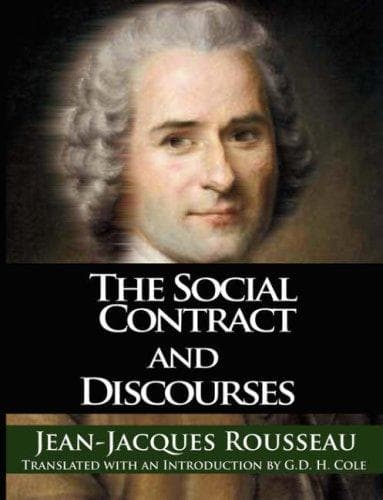
The social contract & discoursesRousseau, Jean-Jacques
Philosophy
The social contract & discourses
Rousseau, Jean-Jacques
Economics; Political science -- Early works to 1800; Social contract
It appears, at first view, that men in a state of nature, having no
moral relations or determinate obligations one with another, could
not be either good nor bad, virtuous or vicious; unless we take these
terms in a physical sense, and call, in an individual, those qualities
vices which may be injurious to his preservation, and those virtues
which contribute to it; in which case, he would have to be accounted
most virtuous, who put least check on the pure impulses of nature.
But without deviating from the ordinary sense of the words, it will
be proper to suspend the judgment we might be led to form on such a
state, and be on our guard against our prejudices, till we have weighed
the matter in the scales of impartiality, and seen whether virtues
or vices preponderate among civilised men; and whether their virtues
do them more good than their vices do harm; till we have discovered,
whether the progress of the sciences sufficiently indemnifies them for
the mischiefs they do one another, in proportion as they are better
informed of the good they ought to do; or whether they would not be,
on the whole, in a much happier condition if they had nothing to fear
or to hope from any one, than as they are, subjected to universal
dependence, and obliged to take everything from those who engage to
give them nothing in return.
Above all, let us not conclude, with Hobbes, that because man has no
idea of goodness, he must be naturally wicked; that he is vicious
because he does not know virtue; that he always refuses to do his
fellow-creatures services which he does not think they have a
right to demand; or that by virtue of the right he truly claims to
everything he needs, he foolishly imagines himself the sole proprietor
of the whole universe. Hobbes had seen clearly the defects of all
the modern definitions of natural right: but the consequences which
he deduces from his own show that he understands it in an equally
false sense. In reasoning on the principles he lays down, he ought
to have said that the state of nature, being that in which the care
for our own preservation is the least prejudicial to that of others,
was consequently the best calculated to promote peace, and the most
suitable for mankind. He does say the exact opposite, in consequence
of having improperly admitted, as a part of savage man's care for
self-preservation, the gratification of a multitude of passions which
are the work of society, and have made laws necessary. A bad man, he
says, is a robust child. But it remains to be proved whether man in
a state of nature is this robust child: and, should we grant that he
is, what would he infer? Why truly, that if this man, when robust and
strong, were dependent on others as he is when feeble, there is no
extravagance he would not be guilty of; that he would beat his mother
when she was too slow in giving him her breast; that he would strangle
one of his younger brothers, if he should be troublesome to him, or
Public-domain text, read in full here on John Shaqi.
Reviews
Reviews
No reviews yet
Be the first to share your thoughts on this work.
Elsewhere in the archive
Join the Discussion
Join the discussion
Sign in to leave a comment or review.
Sign InorCreate an account