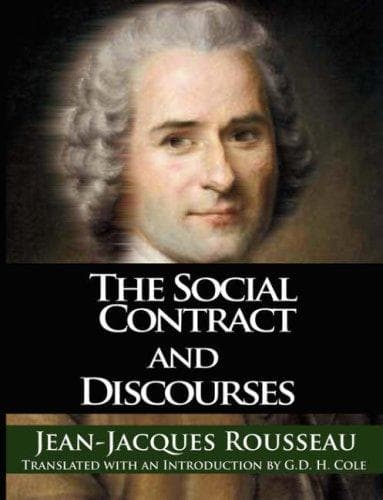
The social contract & discoursesRousseau, Jean-Jacques
Philosophy
The social contract & discourses
Rousseau, Jean-Jacques
Economics; Political science -- Early works to 1800; Social contract
As ideas and feelings succeeded one another, and heart and head
were brought into play, men continued to lay aside their original
wildness; their private connections became every day more intimate
as their limits extended. They accustomed themselves to assemble
before their huts round a large tree; singing and dancing, the true
offspring of love and leisure, became the amusement, or rather the
occupation, of men and women thus assembled together with nothing
else to do. Each one began to consider the rest, and to wish to be
considered in turn; and thus a--value came to be attached to public
esteem. Whoever sang or danced best, whoever was the handsomest, the
strongest, the most dexterous, or the most eloquent, came to be of
most consideration; and this was the first step towards inequality,
and at the same time towards vice. From these first distinctions arose
on the one side vanity and contempt and on the other shame and envy:
and the fermentation caused by these new leavens ended by producing
combinations fatal to innocence and happiness.
As soon as men began to value one another, and the idea of
consideration had got a footing in the mind, every one put in his claim
to it, and it became impossible to refuse it to any with impunity.
Hence arose the first obligations of civility even among savages; and
every intended injury became an affront; because, besides the hurt
which might result from it, the party injured was certain to find in it
a contempt for his person, which was often more insupportable than the
hurt itself.
Thus, as every man punished the contempt shown him by others, in
proportion to his opinion of himself, revenge became terrible, and men
bloody and cruel. This is precisely the state reached by most of the
savage nations known to us: and it is for want of having made a proper
distinction in our ideas, and seen how very far they already are from
the state of nature, that so many writers have hastily concluded that
man is naturally cruel, and requires civil institutions to make him
more mild; whereas nothing is more gentle than man in his primitive
state, as he is placed by nature at an equal distance from the
stupidity of brutes, and the fatal ingenuity of civilised man. Equally
confined by instinct and reason to the sole care of guarding himself
against the mischiefs which threaten him, he is restrained by natural
compassion from doing any injury to others, and is not led to do such a
thing even in return for injuries received. For, according to the axiom
of the wise Locke, _There can be no injury, where there is no property_.
Public-domain text, read in full here on John Shaqi.
Reviews
Reviews
No reviews yet
Be the first to share your thoughts on this work.
Elsewhere in the archive
Join the Discussion
Join the discussion
Sign in to leave a comment or review.
Sign InorCreate an account