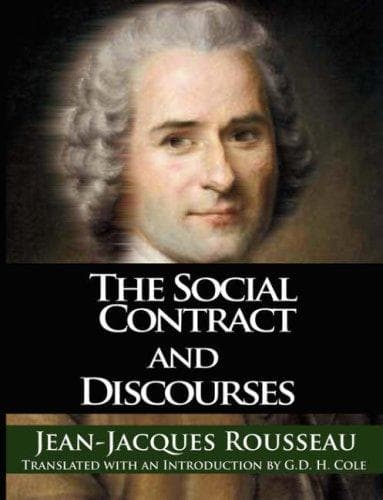
The social contract & discoursesRousseau, Jean-Jacques
Philosophy
The social contract & discourses
Rousseau, Jean-Jacques
Economics; Political science -- Early works to 1800; Social contract
Government had, in its infancy, no regular and constant form. The want
of experience and philosophy prevented men from seeing any but present
inconveniences, and they thought of providing against others only as
they presented themselves. In spite of the endeavours of the wisest
legislators, the political state remained imperfect, because it was
little more than the work of chance; and, as it had begun ill, though
time revealed its defects and suggested remedies, the original faults
were never repaired. It was continually being patched up, when the
first task should have been to get the site cleared and all the old
materials removed, as was done by Lycurgus at Sparta, if a stable and
lasting edifice was to be erected. Society consisted at first merely of
a few general conventions, which every member bound himself to observe;
and for the performance of covenants the whole body went security to
each individual. Experience only could show the weakness of such a
constitution, and how easily it might be infringed with impunity, from
the difficulty of convicting men of faults, where the public alone
was to be witness and judge: the laws could not but be eluded in many
ways; disorders and inconveniences could not but multiply continually,
till it became necessary to commit the dangerous trust of public
authority to private persons, and the care of enforcing obedience to
the deliberations of the people to the magistrate. For to say that
chiefs were chosen before the confederacy was formed, and that the
administrators of the laws were there before the laws themselves, is
too absurd a supposition to consider seriously.
It would be as unreasonable to suppose that men at first threw
themselves irretrievably and unconditionally into the arms of an
absolute master, and that the first expedient which proud and
unsubdued men hit upon for their common security was to run headlong
into slavery. For what reason, in fact, did they take to themselves
superiors, if it was not in order that they might be defended from
oppression, and have protection for their lives, liberties and
properties, which are, so to speak, the constituent elements of their
being? Now, in the relations between man and man, the worst that can
happen is for one to find himself at the mercy of another, and it would
have been inconsistent with common-sense to begin by bestowing on a
chief the only things they wanted his help to preserve. What equivalent
could he offer them for so great a right? And if he had presumed to
exact it under pretext of defending them, would he not have received
the answer recorded in the fable: "What more can the enemy do to us?"
It is therefore beyond dispute, and indeed the fundamental maxim of
all political right, that people have set up chiefs to protect their
liberty, and not to enslave them. _If we have a prince_, said Pliny to
Trajan, _it is to save ourselves from having a master_.
Public-domain text, read in full here on John Shaqi.
Reviews
Reviews
No reviews yet
Be the first to share your thoughts on this work.
Elsewhere in the archive
Join the Discussion
Join the discussion
Sign in to leave a comment or review.
Sign InorCreate an account