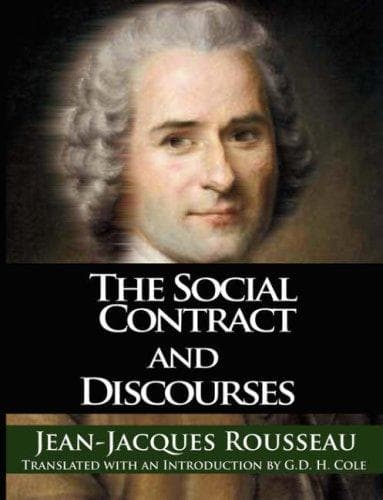
The social contract & discoursesRousseau, Jean-Jacques
Philosophy
The social contract & discourses
Rousseau, Jean-Jacques
Economics; Political science -- Early works to 1800; Social contract
In establishing the general will as the first principle of public
_economy_, and the fundamental rule of government, I have not thought
it necessary to inquire seriously whether the Magistrates belong to the
people, or the people to the Magistrates; or whether in public affairs
the good of the State should be taken into account, or only that of
its rulers. That question indeed has long been decided one way in
theory, and another in practice; and in general it would be ridiculous
to expect that those who are in fact masters will prefer any other
interest to their own. It would not be improper, therefore, further to
distinguish public _economy_ as popular or tyrannical. The former is
that of every State, in which there reigns between the people and the
rulers unity of interest and will: the latter will necessarily exist
wherever the government and the people have different interests, and,
consequently, opposing wills. The rules of the latter are written at
length in the archives of history, and in the satires of Macchiavelli.
The rules of the former are found only in the writings of those
philosophers who venture to proclaim the rights of humanity.
I. The first and most important rule of legitimate or popular
government, that is to say, of government whose object is the good of
the people, is therefore, as I have observed, to follow in everything
the general will. But to follow this will it is necessary to know it,
and above all to distinguish it from the particular will, beginning
with one's self: this distinction is always very difficult to make,
and only the most sublime virtue can afford sufficient illumination
for it. As, in order to will, it is necessary to be free, a difficulty
no less great than the former arises--that of preserving at once the
public liberty and the authority of government. Look into the motives
which have induced men, once united by their common needs in a general
society, to unite themselves still more intimately by means of civil
societies: you will find no other motive than that of assuring the
property, life and liberty of each member by the protection of all.
But can men be forced to defend the liberty of any one among them,
without trespassing on that of others? And how can they provide for
the public needs, without alienating the individual property of those
who are forced to contribute to them? With whatever sophistry all this
may be covered over, it is certain that if any constraint can be laid
on my will, I am no longer free, and that I am no longer master of my
own property, if any one else can lay a hand on it. This difficulty,
which would have seemed insurmountable, has been removed, like the
first, by the most sublime of all human institutions, or rather by a
divine inspiration, which teaches mankind to imitate here below the
unchangeable decrees of the Deity. By what inconceivable art has a
means been found of making men free by making them subject; of using in
Public-domain text, read in full here on John Shaqi.
Reviews
Reviews
No reviews yet
Be the first to share your thoughts on this work.
Elsewhere in the archive
Join the Discussion
Join the discussion
Sign in to leave a comment or review.
Sign InorCreate an account