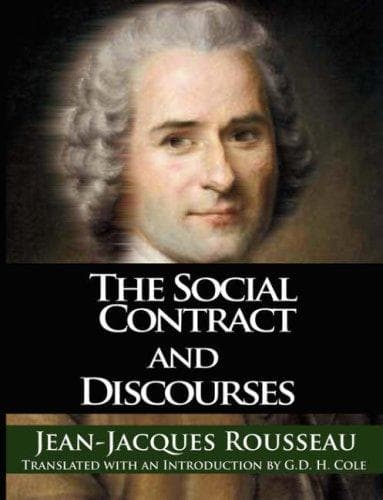
The social contract & discoursesRousseau, Jean-Jacques
Philosophy
The social contract & discourses
Rousseau, Jean-Jacques
Economics; Political science -- Early works to 1800; Social contract
The power of the laws depends still more on their own wisdom than on
the severity of their administrators, and the public will derives its
greatest weight from the reason which has dictated it. Hence Plato
looked upon it as a very necessary precaution to place at the head of
all edicts a preamble, setting forth their justice and utility. In
fact, the first of all laws is to respect the laws: the severity of
penalties is only a vain resource, invented by little minds in order
to substitute terror for that respect which they have no means of
obtaining. It has constantly been observed that in those countries
where legal punishments are most severe, they are also most frequent;
so that the cruelty of such punishments is a proof only of the
multitude of criminals, and, punishing everything with equal severity,
induces those who are guilty to commit crimes, in order to escape being
punished for their faults.
But though the government be not master of the law, it is much to be
its guarantor, and to possess a thousand means of inspiring the love
of it. In this alone the talent of reigning consists. With force in
one's hands, there is no art required to make the whole world tremble,
nor indeed much to gain men's hearts; for experience has long since
taught the people to give its rulers great credit for all the evil they
abstain from doing it, and to adore them if they do not absolutely hate
it. A fool, if he be obeyed, may punish crimes as well as another: but
the true statesman is he who knows how to prevent them: it is over the
wills, even more than the actions, of his subjects that his honourable
rule is extended. If he could secure that every one should act aright,
he would no longer have anything to do; and the masterpiece of his
labours would be to be able to remain unemployed. It is certain, at
least, that the greatest talent a ruler can possess is to disguise his
power, in order to render it less odious, and to conduct the State so
peaceably as to make it seem to have no need of conductors.
Public-domain text, read in full here on John Shaqi.
Reviews
Reviews
No reviews yet
Be the first to share your thoughts on this work.
Elsewhere in the archive
Join the Discussion
Join the discussion
Sign in to leave a comment or review.
Sign InorCreate an account