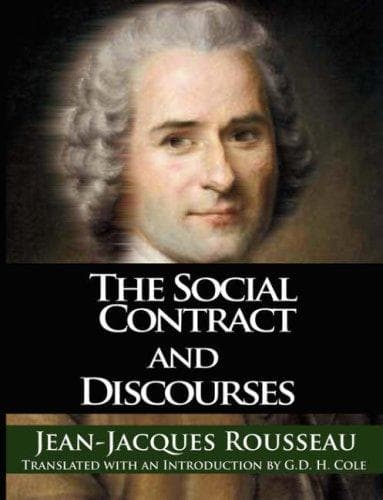
The social contract & discoursesRousseau, Jean-Jacques
Philosophy
The social contract & discourses
Rousseau, Jean-Jacques
Economics; Political science -- Early works to 1800; Social contract
It is further to be noticed that the resources of commerce and industry
are so far from rendering the tax more supportable through abundance
of money, that they only render it more burdensome. I shall not insist
on what is very evident; _i.e._ that, although a greater or less
quantity of money in a State may give it the greater or less credit in
the eye of the foreigner, it makes not the least difference to the
real fortune of the citizens, and does not make their condition any
more or less comfortable. But I must make these two important remarks:
first, unless a State possesses superfluous commodities, and abundance
of money results from foreign trade, only trading cities are sensible
of the abundance; while the peasant only becomes relatively poorer.
Secondly, as the price of everything is enhanced by the increase of
money, taxes also must be proportionately increased; so that the farmer
will find himself still more burdened without having more resources.
It ought to be observed that the tax on land is a real duty on the
produce. It is universally agreed, however, that nothing is so
dangerous as a tax on corn paid by the purchaser: but how comes it we
do not see that it is a hundred times worse when the duty is paid by
the cultivator himself? Is not this an attack on the substance of the
State at its very source? Is it not the directest possible method of
depopulating a country, and therefore in the end ruining it? For the
worst kind of scarcity a nation can suffer from is lack of inhabitants.
Only the real statesman can rise, in imposing taxes, above the
mere financial object: he alone can transform heavy burdens into
useful regulations, and make the people even doubtful whether such
establishments were not calculated rather for the good of the nation in
general, than merely for the raising of money.
Duties on the importation of foreign commodities, of which the natives
are fond, without the country standing in need of them; on the
exportation of those of the growth of the country which are not too
plentiful, and which foreigners cannot do without; on the productions
of frivolous and all too lucrative arts; on the importation of all pure
luxuries; and in general on all objects of luxury; will answer the
two-fold end in view. It is by such taxes, indeed, by which the poor
are eased, and the burdens thrown on the rich, that it is possible to
prevent the continual increase of inequality of fortune; the subjection
of such a multitude of artisans and useless servants to the rich, the
multiplication of idle persons in our cities, and the depopulation of
the country-side.
Public-domain text, read in full here on John Shaqi.
Reviews
Reviews
No reviews yet
Be the first to share your thoughts on this work.
Elsewhere in the archive
Join the Discussion
Join the discussion
Sign in to leave a comment or review.
Sign InorCreate an account