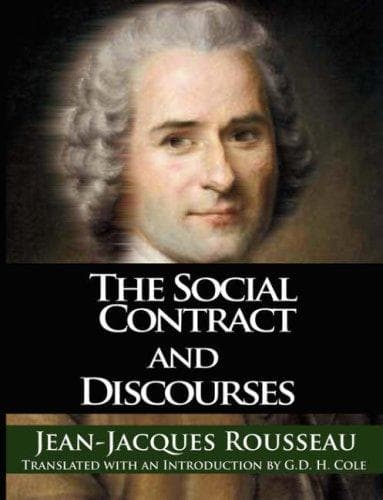
The social contract & discoursesRousseau, Jean-Jacques
Philosophy
The social contract & discourses
Rousseau, Jean-Jacques
Economics; Political science -- Early works to 1800; Social contract
In the person of the magistrate we can distinguish three essentially
different wills: first, the private will of the individual, tending
only to his personal advantage; secondly, the common will of the
magistrates, which is relative solely to the advantage of the prince,
and may be called corporate will, being general in relation to the
government, and particular in relation to the State, of which the
government forms part; and, in the third place, the will of the people
or the sovereign will, which is general both in relation to the State
regarded as the whole, and to the government regarded as a part of the
whole.
In a perfect act of legislation, the individual or particular will
should be at zero; the corporate will belonging to the government
should occupy a very subordinate position; and, consequently, the
general or sovereign will should always predominate and should be the
sole guide of all the rest.
According to the natural order, on the other hand, these different
wills become more active in proportion as they are concentrated. Thus,
the general will is always the weakest, the corporate will second, and
the individual will strongest of all: so that, in the government, each
member is first of all himself, then a magistrate, and then a citizen
--in an order exactly the reverse of what the social system requires.
This granted, if the whole government is in the hands of one man, the
particular and the corporate will are wholly united, and consequently
the latter is at its highest possible degree of intensity. But, as the
use to which the force is put depends on the degree reached by the
will, and as the absolute force of the government is invariable, it
follows that the most active government is that of one man.
Suppose, on the other hand, we unite the government with the
legislative authority, and make the Sovereign prince also, and all the
citizens so many magistrates: then the corporate will, being confounded
with the general will, can possess no greater activity than that will,
and must leave the particular will as strong as it can possibly be.
Thus, the government, having always the same absolute force, will be at
the lowest point of its relative force or activity.
Public-domain text, read in full here on John Shaqi.
Reviews
Reviews
No reviews yet
Be the first to share your thoughts on this work.
Elsewhere in the archive
Join the Discussion
Join the discussion
Sign in to leave a comment or review.
Sign InorCreate an account