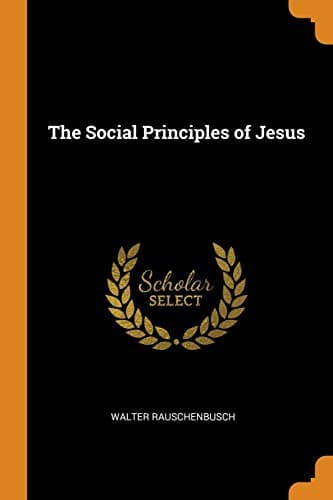
The Social Principles of JesusRauschenbusch, Walter
Religion
The Social Principles of Jesus
Rauschenbusch, Walter
Christian ethics; Christian sociology; Jesus Christ -- Teachings
Other reformers have condemned religious practices because they were
departures from the holy Book or from primitive custom. Jesus, too,
pointed out that some of these regulations were recent innovations. But
the real standard by which he judged current religious questions was not
ancient authority but the present good of men. The spiritual center on
which he took his stand and from which he judged all things, was the
Kingdom of God, the perfect social order. Even the ordinances of religion
must justify themselves by making an effective contribution to the Kingdom
of God. The Sabbath was made for man, and its observance must meet the
test of service to man’s welfare. It must function wholesomely. The candle
must give light, or what is the use of it? The salt must be salty and
preserve from decay, or it will be thrown out and trodden under foot. If
the fig-tree bears no fruit, why is it allowed to use up space and crowd
better plants off the soil? This, then, is Christ’s test in matters of
institutional religion. The Church and all its doings must serve the
Kingdom of God.
II
The social efficiency of religion is a permanent social problem. What is
the annual expense of maintaining the churches in the United States? How
much capital is invested in the church buildings? (See U. S. Census
Bulletin No. 103, of 1906.) How much care and interest and loving
free-will labor does an average village community bestow on religion as
compared with other objects? All men feel instinctively that religion
exerts a profound and subtle influence on the springs of conduct. Even
those who denounce it, acknowledge at least its power for harm. Most of us
know it as a power for good. But all history shows that this great
spiritual force easily deteriorates. _Corruptio optimi pessima._
Religion may develop an elaborate social apparatus of its own, wheels
within wheels, and instead of being a dynamic of righteousness in the
natural social relations of men, its energies may be consumed in driving
its own machinery. Instead of being the power-house supplying the Kingdom
of God among men with power and light, the Church may exist for its own
sake. It then may become an expensive consumer of social wealth, a
conservative clog, and a real hindrance of social progress.
Live religion gives proof of its value by the sense of freedom, peace, and
elation which it creates. We feel we are right with the holy Power which
is behind, and beneath, and above all things. It gives a satisfying
interpretation of life and of our own place in it. It moves our aims
higher up, draws our fellow-men closer, and invigorates our will.
Public-domain text, read in full here on John Shaqi.
Reviews
Reviews
No reviews yet
Be the first to share your thoughts on this work.
Elsewhere in the archive
Join the Discussion
Join the discussion
Sign in to leave a comment or review.
Sign InorCreate an account