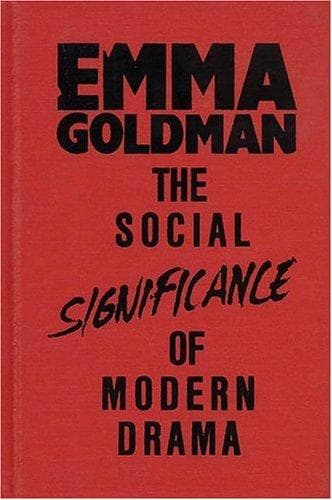
The Social Significance of the Modern DramaGoldman, Emma
History
The Social Significance of the Modern Drama
Goldman, Emma
Drama -- Social aspects; European drama -- History and criticism
Thanks to _Ruth's_ pleading, the firm of _James How & Son_ is willing to
take _Falder_ back in their employ, on condition that he give up
_Ruth_. _Falder_ resents this:
_Falder._ I couldn't give her up. I couldn't! Oh, sir! I'm all she's
got to look to. And I'm sure she's all I've got.
It is then that _Falder_ learns the awful news that the woman he loves
had been driven by the chariot wheel of Justice to sell herself.
_Ruth._ I tried making skirts ... cheap things. It was the best I
could get, but I never made more than ten shillings a week, buying
my own cotton and working all day; I hardly ever got to bed till
past twelve. I kept at it for nine months.... It was starvation for
the children.... And then ... my employer happened--he's happened
ever since.
At this terrible psychologic moment the police appear to drag _Falder_
back to prison for failing to report to the authorities as
ticket-of-leave man.
Completely overcome by the inexorability of his fate, _Falder_ throws
himself down the stairs, breaking his neck.
The socio-revolutionary significance of "Justice" consists not only in
the portrayal of the inhuman system which grinds the Falders and
Honeywills, but even more so in the utter helplessness of society as
expressed in the words of the Senior Clerk, _Cokeson_, "No one'll touch
him now! Never again! He's safe with gentle Jesus!"
THE PIGEON
John Galsworthy calls this play a fantasy. To me it seems cruelly real:
it demonstrates that the best human material is crushed in the fatal
mechanism of our life. "The Pigeon" also discloses to us the inadequacy
of charity, individual and organized, to cope with poverty, as well as
the absurdity of reformers and experimenters who attempt to patch up
effects while they ignore the causes.
_Christopher Wellwyn_, an artist, a man deeply in sympathy with all
human sorrow and failings, generously shares his meager means with
everyone who applies to him for help.
His daughter _Ann_ is of a more practical turn of mind. She cannot
understand that giving is as natural and necessary to her father as
light and air; indeed, the greatest joy in life.
Perhaps _Ann_ is actuated by anxiety for her father who is so utterly
"hopeless" that he would give away his "last pair of trousers." From her
point of view "people who beg are rotters": decent folk would not stoop
to begging. But _Christopher Wellwyn's_ heart is too full of humanity to
admit of such a straight-laced attitude. "We're not all the same....
One likes to be friendly. What's the use of being alive if one isn't?"
Public-domain text, read in full here on John Shaqi.
Reviews
Reviews
No reviews yet
Be the first to share your thoughts on this work.
Elsewhere in the archive
Join the Discussion
Join the discussion
Sign in to leave a comment or review.
Sign InorCreate an account