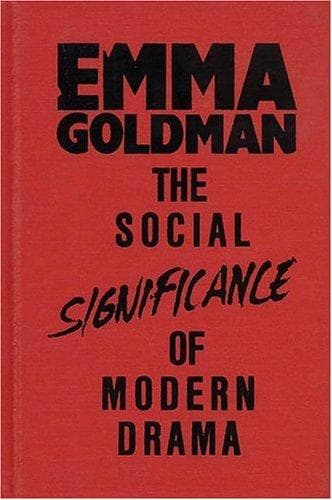
The Social Significance of the Modern DramaGoldman, Emma
History
The Social Significance of the Modern Drama
Goldman, Emma
Drama -- Social aspects; European drama -- History and criticism
It can hardly be that woman is merely a reproducer and not a creator. We
have but to recall such creative artists as Charlotte and Emily Bronté,
George Sand, George Eliot, Mary Wollstonecraft, Marie Bashkirtshev, Rosa
Bonheur, Sophia Kovalevskaya and a host of others, to appreciate that
woman has been a creative factor in literature, art and science. Not so
in the drama, so far the stronghold exclusively of men.
It is therefore an event for a woman to come to the fore who possesses
such dramatic power, realistic grasp and artistic penetration as
evidenced by Githa Sowerby.
The circumstance is the more remarkable because Githa Sowerby is,
according to her publishers, barely out of her teens; and though she be
a genius, her exceptional maturity is a phenomenon rarely observed.
Generally maturity comes only with experience and suffering. No one who
has not felt the crushing weight of the Rutherford atmosphere could have
painted such a vivid and life-like picture.
The basic theme in "Rutherford and Son" is not novel. Turgenev, Ibsen
and such lesser artists as Sudermann and Stanley Houghton have dealt
with it: the chasm between the old and the young,--the tragic struggle
of parents against their children, the one frantically holding on, the
other recklessly letting go. But "Rutherford and Son" is more than that.
It is a picture of the paralyzing effect of tradition and
institutionalism on all human life, growth, and change.
_John Rutherford_, the owner of the firm "Rutherford and Son," is
possessed by the phantom of the past--the thing handed down to him by
his father and which he must pass on to his son with undiminished
luster; the thing that has turned his soul to iron and his heart to
stone; the thing for the sake of which he has never known joy and
because of which no one else must know joy,--"Rutherford and Son."
The crushing weight of this inexorable monster on Rutherford and his
children is significantly summed up by young John:
_John._ Have you ever heard of Moloch? No.... Well, Moloch was a
sort of a God ... some time ago, you know, before Dick and his kind
came along. They built his image with an ugly head ten times the
size of a real head, with great wheels instead of legs, and set him
up in the middle of a great dirty town. And they thought him a very
important person indeed, and made sacrifices to him ... human
sacrifices ... to keep him going, you know. Out of every family they
set aside one child to be an offering to him when it was big enough,
and at last it became a sort of honor to be dedicated in this way,
so much so, that the victims came themselves gladly to be crushed
out of life under the great wheels. That was Moloch.
_Janet._ Dedicated--we are dedicated--all of us--to Rutherfords'.
Public-domain text, read in full here on John Shaqi.
Reviews
Reviews
No reviews yet
Be the first to share your thoughts on this work.
Elsewhere in the archive
Join the Discussion
Join the discussion
Sign in to leave a comment or review.
Sign InorCreate an account