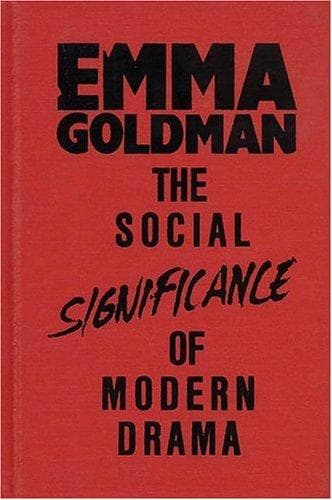
The Social Significance of the Modern DramaGoldman, Emma
History
The Social Significance of the Modern Drama
Goldman, Emma
Drama -- Social aspects; European drama -- History and criticism
Most Americans know about the Irish people only that they are not averse
to drink, and that they make brutal policemen and corrupt politicians.
But those who are familiar with the revolutionary movements of the past
are aware of the fortitude and courage, aye, of the heroism of the
Irish, manifested during their uprisings, and especially in the Fenian
movement--the people's revolt against political despotism and land
robbery.
And though for years Ireland has contributed to the very worst features
of American life, those interested in the fate of its people did not
despair; they knew that the spirit of unrest in Ireland was not
appeased, and that it would make itself felt again in no uncertain form.
The cultural and rebellious awakening in that country within the last
twenty-five years once more proves that neither God nor King can for
long suppress the manifestation of the latent possibilities of a people.
The possibilities of the Irish must indeed be great if they could
inspire the rich humor of a Lady Gregory, the deep symbolism of a Yeats,
the poetic fancy of a Synge, and the rebellion of a Robinson and Murray.
Only a people unspoiled by the dulling hand of civilization and free
from artifice can retain such simplicity of faith and remain so
imaginative, so full of fancy and dreams, wild and fiery, which have
kindled the creative spark in the Irish dramatists of our time. It is
true that the work of only the younger element among them is of social
significance, yet all of them have rendered their people and the rest of
the world a cultural service of no mean value. William Butler Yeats is
among the latter, together with Synge and Lady Gregory; his art, though
deep in human appeal, has no bearing on the pressing questions of our
time. Mr. Yeats himself would repudiate any implication of a social
character, as he considers such dramas too "topical" and therefore "half
bad" plays. In view of this attitude, it is difficult to reconcile his
standard of true art with the repertoire of the Abbey Theater, which
consists mainly of social dramas. Still more difficult is it to account
for his work, "Where There is Nothing," which is no less social in its
philosophy and tendency than Ibsen's "Brand."
WHERE THERE IS NOTHING
"Where There Is Nothing" is as true an interpretation of the philosophy
of Anarchism as could be given by its best exponents. I say this not out
of any wish to tag Mr. Yeats, but because the ideal of _Paul Ruttledge_,
the hero of the play, is nothing less than Anarchism applied to everyday
life.
_Paul Ruttledge_, a man of wealth, comes to the conclusion, after a long
process of development and growth, that riches are wrong, and that the
life of the propertied is artificial, useless and inane.
Public-domain text, read in full here on John Shaqi.
Reviews
Reviews
No reviews yet
Be the first to share your thoughts on this work.
Elsewhere in the archive
Join the Discussion
Join the discussion
Sign in to leave a comment or review.
Sign InorCreate an account