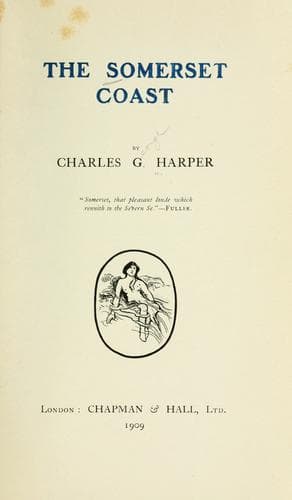
The Somerset CoastHarper, Charles G. (Charles George)
History
The Somerset Coast
Harper, Charles G. (Charles George)
Somerset (England) -- Description and travel
The Luttrells took the Lancastrian side in the quarrels of Red Rose and
White, and suffered severely for that partisanship; Sir James, who had
been knighted for valour at the bloody battle of Wakefield, being
mortally wounded at the battle of Barnet, 1471, and his property
forfeited to the victorious Yorkists, who granted the Luttrell acres to
the Earls of Pembroke. After the battle of Bosworth, however, fourteen
years later, they obtained their own again, and held it uneventfully
until the beginning of hostilities between Cavaliers and Roundheads, in
1642. Mr. George Luttrell, the then owner, garrisoned Dunster Castle for
the Parliamentary party, and held it for a time successfully against the
Marquess of Hertford, the Royalist commander in these parts, established
at Minehead, who was satisfied, in view of the formidable front made by
this hilltop stronghold, in merely keeping a watch upon it, and
preventing any offensive movement on the part of the garrison: thus—to
use a modern military expression—“containing” the enemy. Luttrell, for
his part, was satisfied at keeping the Royalists thus inactive and
useless for offence elsewhere; each side thus “containing” the other: a
not very stirring method of warfare. In the following year, in
consequence of the sequence of Royalist successes in the West, Mr.
Luttrell surrendered the castle, which was then held for three years for
the King by Colonel Francis Windham. It was at this period that Prince
Charles, afterwards Charles the Second, stayed here. The bedroom he then
occupied is still known as “Prince Charles’s.” In those years the
fortunes of the King declined, and rapidly grew desperate; until at last
Dunster Castle became the sole outpost of the cause in Somerset.
Finally, in 1645, it was resolved to reduce this remnant, and in
November of that year a force was despatched from Taunton to besiege the
Castle. The investing force was commanded by Blake, great on sea and on
land, and by Sydenham, and a lengthy and stirring siege began. Both
sides worked vigorously. Attack and defence proceeded on engineering
lines; Blake’s men advancing cautiously by trenches, mines, and
batteries; the defenders pushing forth to meet them by the same
mole-like methods. On February 5th, 1646, in midst of these laborious
operations, when the garrison had come near to being starved out, a
column under Lord Hopton relieved them, and Blake’s men were forced to
retire from beneath the walls. He kept watch, however, upon Dunster, and
in the meanwhile received reinforcements. At length, on April 19th, the
sturdy Windham, convinced that, the King having lost everywhere else in
the West, it would be futile to hold this one remaining post,
surrendered. The victorious Parliament, careful to destroy those places
that had held out against it, duly ordered the Castle of Dunster to be
“slighted,” otherwise to be blown up; but the order was not enforced,
probably for the sufficient reason that the Luttrells, as we have seen,
Public-domain text, read in full here on John Shaqi.
Reviews
Reviews
No reviews yet
Be the first to share your thoughts on this work.
Elsewhere in the archive
Join the Discussion
Join the discussion
Sign in to leave a comment or review.
Sign InorCreate an account