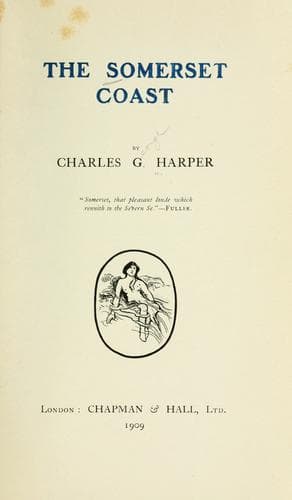
The Somerset CoastHarper, Charles G. (Charles George)
History
The Somerset Coast
Harper, Charles G. (Charles George)
Somerset (England) -- Description and travel
Guide-books tell of the “curious epitaphs” at Porlock, but they are not
so curious as might thus be supposed; certainly not more so than those
of the average country churchyard. The chief feature of these is their
ungrammatical character, as where we read of Henry Pulsford and Richard
Bale, “who was both drownd” at “Lymouth,” in 1784. Poetry—or rather,
verse—that changed, in arbitrary fashion, from first person to third,
was still possible in 1860, as witness these unpleasant lines upon one
Thomas Fry:
For many weeks my friends did see
Approaching death attending me.
No favour could his body find,
Till in the earth it was confined,
and so forth.
The “Ship” inn is almost, if not even quite, as well known a feature of
Porlock as the church, and is unaltered since Southey sheltered here
considerably over a hundred years ago—
By the unwelcome summer rain confined.
The thatch has, of course, been renewed from time to time, but always in
the old traditional style, and the white walls are obviously what they
were a couple of centuries or more ago. The oldest part of the inn is
probably a curious little trefoiled-headed wooden window, of
semi-ecclesiastical design, under the eaves.
[Illustration: INGLENOOK, “SHIP” INN, PORLOCK.]
Southey sat in the little parlour still existing, and, by the inglenook
that has fortunately been preserved, wrote the oft-quoted lines:
Porlock, thy verdant vale, so fair to sight,
Thy lofty hills, which fern and furze embrown,
Thy waters, that roll musically down
Thy woody glens, the traveller with delight
Recalls to memory, and the channel grey
Circling it, surging in thy level bay.
[Illustration: “THE SHIP” INN, PORLOCK.]
A small window in this chimney-corner commands a view up the road, just
as of old, where the famed “Porlock Hill” begins that steep and
long-continued rise which has made it known, far and near, as “the worst
hill in the West of England.” This is a mile-long rise from Porlock Vale
to the wild, exposed tableland that stretches, for seven miles, to
Countisbury, where it descends steeply to Lynmouth. The rise of Porlock
Hill is one thousand feet, but the tableland beyond it rises yet another
378 feet by Culbone Hill. The gradient of Porlock Hill is in parts as
steep as one in six, and the surface is always, at all seasons of the
year, bad in the extreme. A sharp bend to the right appears, a little
way uphill. In summer a mass of red dust six or eight inches deep, and
plentifully mixed with large stones, it is in winter a pudding-like
mixture of a clayey nature. The spectacle of heavy-laden coaches toiling
up this fearsome so-called “road” is a distressing one for those who
love horses, and grieve to see them overtaxed. No cyclist could, of
course, hope to ride up, while none but a madman would attempt to ride
down.
Public-domain text, read in full here on John Shaqi.
Reviews
Reviews
No reviews yet
Be the first to share your thoughts on this work.
Elsewhere in the archive
Join the Discussion
Join the discussion
Sign in to leave a comment or review.
Sign InorCreate an account