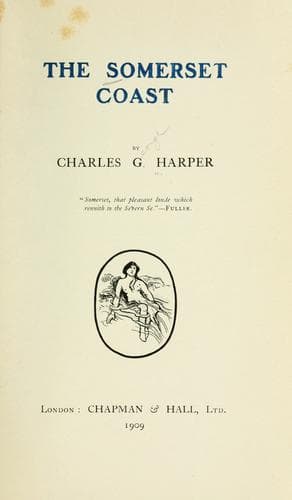
The Somerset CoastHarper, Charles G. (Charles George)
History
The Somerset Coast
Harper, Charles G. (Charles George)
Somerset (England) -- Description and travel
OARE—MALMSMEAD—THE BADGWORTHY VALLEY—THE “DOONE VALLEY”—GLENTHORNE
AND now, after having fully considered the evidence for and against the
much-debated existence of these old reprobates and masterless men, let
us advance into their country, and into that of the romantic Lorna, who
was, of course, an adopted Doone merely.
[Illustration: OARE CHURCH.]
The way to Oare, branching off to the left, plunges immediately down
into the profound valley of the Oare Water. “Hookway Hill” is the name
of this abominable road, bad enough in its own native vileness, but
rendered worse by the strange humour of the local road-repairing
authority, always at pains to deposit cartloads of stones on it in the
summer, so that there shall be plenty of opportunity for the tourist
traffic to roll this loose material in by the autumn. Thus the literary
pilgrim to the scenes of “Lorna Doone” is made to earn that title,
eloquent as it is of suffering and difficulties encountered, wrestled
with, and overcome. Long is the way and steep and winding, and he who,
cycling, would seek to avoid the prodigious stones by tracking to the
side, must make his account with the yard-long projecting blackberry
brambles, armed with monstrous thorns, that curry-comb the face, clutch
off the cap, or take one by the arm in a confidential grip, like some
old friend who would bid you “wait a bit.” Later on in the year,
possibly, hedgers will be at work with their “riphooks,” slashing off
these terrors of the way, and then woe to the cyclist’s tyres! It is a
nice point, where and when the blackberry bramble is most offensive;
when it is in a position to scarify the traveller’s person, or when,
shorn off and lying in the road, its thorns play havoc with
india-rubber.
[Illustration: NEAR ROBBER’S BRIDGE.]
At the foot of Hookway Hill, the peaty little Oare, or Weir, water,
rushing over a pebbly bed is crossed by Robber’s Bridge, and
thenceforward the road runs level, past Oareford, and then as an
exceedingly narrow lane, to Oare; passing two or three solitary farms
that in these latter days provide for summer visitors whose humour is
for a fortnight or a month in the wilds. One of these is identified,
more or less accurately, with the “Plovers Barrows’ Farm” of the novel.
Public-domain text, read in full here on John Shaqi.
Reviews
Reviews
No reviews yet
Be the first to share your thoughts on this work.
Elsewhere in the archive
Join the Discussion
Join the discussion
Sign in to leave a comment or review.
Sign InorCreate an account