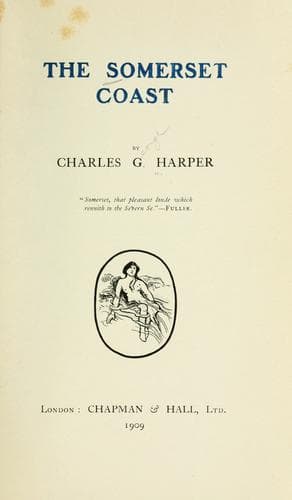
The Somerset CoastHarper, Charles G. (Charles George)
History
The Somerset Coast
Harper, Charles G. (Charles George)
Somerset (England) -- Description and travel
A great deal of argument has been expended upon the name of Bridgwater.
The name is apparently of the most obvious and elementary derivation,
for here is the “water” (largely impregnated, it is true, with mud) in
the river Parret, and here is the bridge, the modern representative of
others of different degrees of antiquity, erected at the lowest place
down the estuary where it was possible to fling a bridge across. It is
evident, then, that it must ever have been impossible to enter or leave
the town in an easterly or westerly direction without crossing a bridge
or ferry at this point. Other place-names in the district, those of
Highbridge and Boroughbridge, for example, prove the word “bridge” to
have been used in the ordinary way, when necessary, as an integral, and
indeed scarcely avoidable, part of a name. Yet the derivation of
“Bridgwater” has nothing to do, explicitly, with water, although
“Brugge,” _i.e._ Bridge, the name of the place at the time of the
Conquest, certainly implies water beneath. The manor was given, after
the Conquest, to one of the Conqueror’s Norman barons, Walter of Douai,
and became therefrom known as “Brugie of Walter” and by degrees, by a
natural elision of letters readily dropped in ordinary speech, what it
is now.
[Illustration: BIRTHPLACE OF ADMIRAL BLAKE]
Of the Castle of Bridgwater, once a strong fortress, both by virtue of
its own stout walls, and by reason of the fine position it held at the
crossing of the Parret, nothing is left, except portions of the Water
Gate, on the West Quay, and the cellars of what is now the Custom House.
The last occasion of its appearance in history was the shameful
surrender of it to a besieging army under Fairfax, on July 23rd, 1645,
after a two days’ assault. It had been so generally considered
impregnable that the wealthy Royalists of the countryside, afraid for
the safety of their jewellery and other valuables, had sent them hither
from what they thought to be the insecurity of their own houses. Thus
the taking of the impregnable castle and the surrender of the invincible
garrison resulted in exceptionally heavy spoils, amounting to £100,000
value.
Public-domain text, read in full here on John Shaqi.
Reviews
Reviews
No reviews yet
Be the first to share your thoughts on this work.
Elsewhere in the archive
Join the Discussion
Join the discussion
Sign in to leave a comment or review.
Sign InorCreate an account