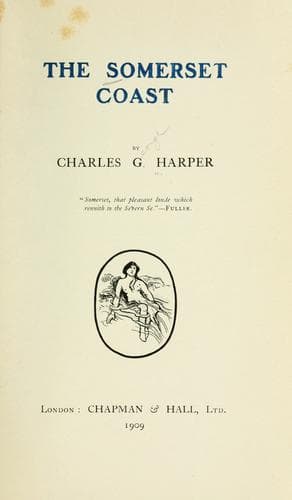
The Somerset CoastHarper, Charles G. (Charles George)
History
The Somerset Coast
Harper, Charles G. (Charles George)
Somerset (England) -- Description and travel
Now, there is nothing that more disheartens untrained men than a check
in their forward march. Countermarching to them appears but the
forerunner of defeat, and the flow of ardour in any cause once hindered
is difficult to recover. With regular troops the chances and changes
incidental to campaigning inure them to disappointments, and the retreat
of to-day they know often to be but the prelude of to-morrow’s advance.
But with Monmouth’s men, their leader’s plan once altered, their
fortunes seemed irretrievably clouded. Monmouth himself grew gloomy at
the delay the vacillations of himself and his lieutenants had caused,
and when on the afternoon of Sunday, July 5th, he ascended to this point
to reconnoitre the position his opponents had taken up in the midst of
the moor, his heart sank. He saw the glint of their arms, the colours of
the regiments drawn up beneath the shadow of the tall tower of
Westonzoyland, and he well knew that a conflict between them and his
brave, but untaught, peasants could only prove fatal to his ambitions.
He had, some years before, led those very soldiers to victory. “I know
those men,” said he to his officers, leaning over these parapets of St.
Mary’s; “they will fight!”
By a circuitous route, his army left the town of Bridgwater when night
was come and darkness had shrouded the moor. By narrow and rugged lanes
they went, past Chedzoy, towards the Polden Hills. Here they turned,
and, led by a guide, essayed to thread the maze of deep ditches called,
in the parlance of the West Country, “Rhines.”
It was not until two o’clock in the morning that they had reached within
striking distance of the Royal troops, crossing safely the Black Ditch,
and moving along the outer side of the Langmoor Rhine, in search of a
passage, when a pistol was fired, either by accident or treachery. “A
Dark night,” says one who was present, “and Thick Fogg covering the
Moore.” The darkness and the sudden alarm caused by the pistol-shot
threw Monmouth’s men into confusion, and the Royal forces were at the
same time aroused. The night attack had failed.
James II.’s troops challenged the masses of men they saw dimly advancing
through the mist, and were for a time deceived by the answering cry of
“Albemarle,” the name of the Royalist commander, who was supposed to be
coming to the support of Lord Feversham.
And thus the Monmouth men passed on to the Bussex Rhine, where they were
simultaneously challenged and fired upon by another outpost. Dismayed by
this volley at close quarters, the rebel horse, forming the advance,
broke and dashed wildly back into the stolid ranks of the peasantry. It
says much for the stubborn courage of those ploughmen and hedgers and
ditchers who formed the bulk of the Duke’s ranks, that in this confusion
they stood fast.
Public-domain text, read in full here on John Shaqi.
Reviews
Reviews
No reviews yet
Be the first to share your thoughts on this work.
Elsewhere in the archive
Join the Discussion
Join the discussion
Sign in to leave a comment or review.
Sign InorCreate an account