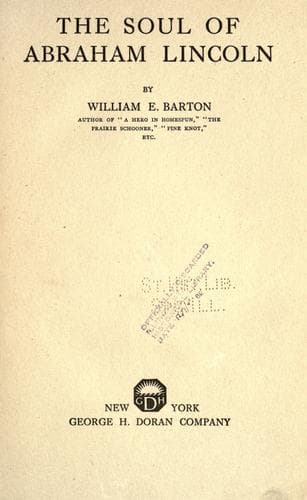
The Soul of Abraham LincolnBarton, William E. (William Eleazar)
Religion
The Soul of Abraham Lincoln
Barton, William E. (William Eleazar)
Lincoln, Abraham, 1809-1865 -- Religion; Presidents -- United States -- Biography
"'As you have asked from me a candid statement of my recollections on
this topic, I have thus briefly given them, with the hope that they
may be of some service in rightly settling a question about which--as
I have good reason to believe--the public mind has been greatly misled.
"'Not doubting that they will accord, substantially, with your own
recollections, and that of his other intimate and confidential
friends, and with the popular verdict after this matter shall have
been properly canvassed, I submit them.'"--LAMON: _Life of Lincoln_,
pp. 490, 491, 492.
Herndon was attempting to collect evidence that Lincoln was an infidel,
and what he obtained, and what essentially he was called to certify
and did certify in effect, was that Lincoln's views were in essential
accord with those of Theodore Parker and William Ellery Channing.
Theodore Parker was not an orthodox Christian according to the
standards of Dr. Smith's church, or of the church of which the present
writer is pastor, but he was a Christian, and a very brave and noble
Christian. William Ellery Channing's views were not in full accord with
the orthodoxy of his day, but he was a noble friend of God and man, and
a true Christian.
I have already referred to the very loose and inexact way in which
Herndon and others use the term "infidel" as applied to Lincoln. Such
inexactness is subversive of all clear thinking.
We are told, for instance, that he was an infidel, his views being
essentially those of Theodore Parker and William Ellery Channing. I
doubt if he ever read very deeply in the writings of these men; but
that he read portions of them and approved of some of their noblest and
most characteristic utterances, is certain. What were the discourses
of these two men which he must almost certainly have read if he read
anything of theirs? He would almost certainly have read Parker's
discourse on "The Transient and Permanent in Christianity," and that
on "Immortal Life," and Channing's Baltimore address and his discourse
on the Church. And these are just the sort of utterances which he
would have read with approval as he found them in these discourses of
Theodore Parker:
Public-domain text, read in full here on John Shaqi.
Reviews
Reviews
No reviews yet
Be the first to share your thoughts on this work.
Elsewhere in the archive
Join the Discussion
Join the discussion
Sign in to leave a comment or review.
Sign InorCreate an account