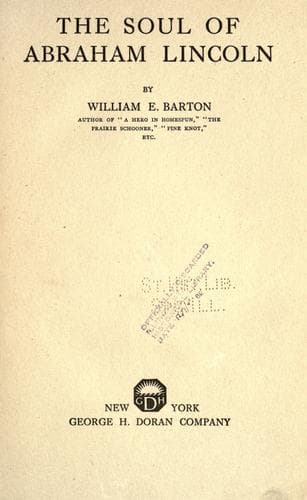
The Soul of Abraham LincolnBarton, William E. (William Eleazar)
Religion
The Soul of Abraham Lincoln
Barton, William E. (William Eleazar)
Lincoln, Abraham, 1809-1865 -- Religion; Presidents -- United States -- Biography
"That Lincoln was an orthodox Christian nobody pretends to assert. But
his friends and biographers differ as to how much of a Christian he
was. If Lincoln had lived and died an obscure Springfield lawyer and
politician, he would unquestionably have been classed by his neighbors
among freethinkers. But as is customary with the Church, whether Roman
Catholic or Protestant, when Lincoln became one of the great of the
world, an attempt was made to claim him.... The shrewd politician who
has not an elastic conscience--and that was Lincoln's case--simply
keeps mum on religious subjects, or, when he must touch on the
subject, deals only in platitudes, and this is just what Lincoln
did. Lincoln thought little on religious subjects, and read less.
That, when left to himself, he was quite indifferent to religion, is
frequently evident in the acts of his life."--_Open Court_, September
24, 1891, pp. 2962-63, quoting _Westminster Review_ of September, 1890.
This statement was not sufficiently radical for one reader of the _Open
Court_, who thought that Mr. Stanton had made Lincoln out to have been
virtually an agnostic, and who wished to prove him an atheist. He wrote
an article in which he said:
"Free-thinker means anything or nothing.... Plain words are the best.
That Lincoln was _A-theos_ connotes a definite attitude toward the
great religious chimera, and really defines Mr. Lincoln's position
more closely than any of Mr. Stanton's epithets [as, e.g., Agnostic].
It is positive, not negative, indicates what the man professedly was
rather than what he was not or what he oppugned. We are in position to
define his life-creed with all due measure of exactness."--"What Was
Abraham Lincoln's Creed?" by George M. McCrie, _Open Court_, November
26, 1891.
This writer then proceeded to define Mr. Lincoln's creed in terms
of atheism. But his argument was based on a subjective scheme of
philosophy, a kind of Hylo-Idealism derived from Hegel more than from
Lincoln, and one which it is safe to affirm Lincoln would neither have
admitted nor even understood.
Some time after, the same journal had a third and very different
article, which said:
Public-domain text, read in full here on John Shaqi.
Reviews
Reviews
No reviews yet
Be the first to share your thoughts on this work.
Elsewhere in the archive
Join the Discussion
Join the discussion
Sign in to leave a comment or review.
Sign InorCreate an account