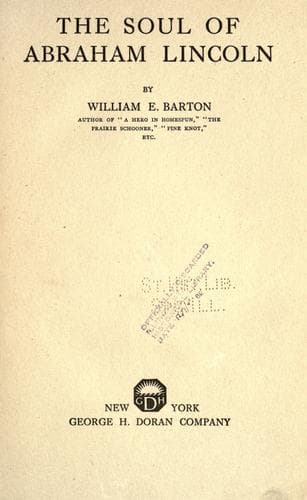
The Soul of Abraham LincolnBarton, William E. (William Eleazar)
Religion
The Soul of Abraham Lincoln
Barton, William E. (William Eleazar)
Lincoln, Abraham, 1809-1865 -- Religion; Presidents -- United States -- Biography
"Religion is always a kind of poetry. Faith is kin to imagination;
both faith and imagination look upon the unseen and refuse to base
life merely upon the senses or upon mathematical formularies like the
law of the inverse squares. This poetry is often quite dissociated
from philosophy, or is even inconsistent with the philosophy which the
individual entertains. But Mr. Lincoln's early philosophy prepared for
his later religious experience. Mr. Herndon reports him as saying:
'There are no accidents in my philosophy. The past is the cause of
the present, and the present will be the cause of the future. All
these are links in the endless chain stretching from the Infinite to
the finite.' With this philosophy of fatalism was a profound faith in
justice, a profound reverence for it, and an uncompromising obedience
to it. At first he did not put this philosophy and this faith
together. He who does put them together, that is, he who infuses this
philosophy in an overruling cause with this faith, which is a 'kind
of poetry,' in the supremacy of righteousness, comes to a faith in a
righteous God, who deserves our reverence, not because he is great,
but because he is good.
"When Abraham Lincoln began to feel the burden of the nation resting
upon him, and felt it too great a burden for him to carry unaided,
he wanted the sympathy of all men and women in the country who with
him believed in a Power directing the course of human history greater
than the actors in it, and who also believed in eternal justice; and
he asked their prayers. As the conflict went on and the burden grew
heavier and heavier, his faith in righteousness more and more infused
his belief in a superhuman power and transformed it into a belief in a
righteous God; but it was, till the last, a belief in a God of justice
rather than a Christ of pity, even as it phrased itself in that most
religious utterance of his life, his second inaugural: 'Fondly do
we hope, fervently do we pray, that this mighty scourge of war may
speedily pass away. Yet if God wills that it continue until all the
wealth piled by the bondman's two hundred years of unrequited toil
shall be sunk, and until every drop of blood drawn with the lash shall
be paid with another drawn with the sword, as was said three thousand
years ago, so still it must be said, "The judgments of the Lord are
true and righteous altogether."'
Public-domain text, read in full here on John Shaqi.
Reviews
Reviews
No reviews yet
Be the first to share your thoughts on this work.
Elsewhere in the archive
Join the Discussion
Join the discussion
Sign in to leave a comment or review.
Sign InorCreate an account