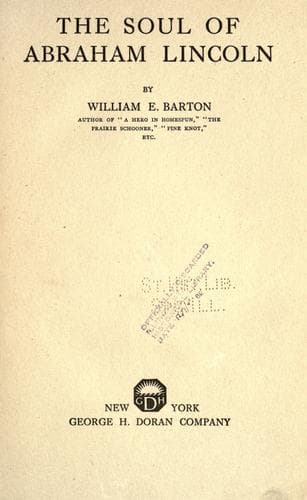
The Soul of Abraham LincolnBarton, William E. (William Eleazar)
Religion
The Soul of Abraham Lincoln
Barton, William E. (William Eleazar)
Lincoln, Abraham, 1809-1865 -- Religion; Presidents -- United States -- Biography
"Court week was always anticipated with great interest by the people
of the county seat. It was customary for the entire bar of the
district to follow the court from county to county, every man either
seeking new business, or as counsel in cases already on the docket.
The date of their arrival at any particular county seat could not be
definitely fixed, as the judge held court at his pleasure, usually
trying to finish all the business ahead before he migrated to the next
station.
"He was followed by a curious crowd. Lawyers, clients, witnesses,
itinerant peddlers, showmen, and gamblers filled the towns to
overflowing. It was no unusual thing for men who had no business in
the court, to follow from town to town merely seeking entertainment.
Social events of any moment were wont to be arranged for court week,
as the harvest time when strangers could be taken in. Taverns were
crowded and the hospitality of the people was taxed to the utmost
limit.
"To the men of the town, who always crowded the court house, the
examination of witnesses and the speeches of the lawyers furnished
an intellectual treat, for there were giants at that bar. There was
David Davis, the companionable judge, who knew the law and who loved
a laugh. And there were Stephen Logan the scholarly, and Stuart the
shrewd and kindly, Swett the clever, and Browning the handsome, and
Lamon the amusing, and Weldon and Gridley and Parks and Harmon and
Ficklin and Linder and Whitney and Oliver L. Davis, and the best
beloved Abraham Lincoln. Some of them traveled to only two or three
counties, but Judge Davis, Mr. Lincoln and Leonard Swett went the
whole circuit; Davis because he had to, Lincoln because he loved it,
and Swett because he loved their company.
"The Macon House was an oasis in the wilderness of miserable inns at
which they were usually compelled to 'put in.' In Decatur they found
clean beds, good bread and an abundance of the good things of the
season, administered by a genial landlady who greeted them all as
friends.
"It was in court week that my piano, after a long journey by steamer
down the Ohio and up the Wabash to Crawfordsville, Ind., and thence
by wagon, arrived in Decatur. The wagon was backed up to the steps at
the front door of the Macon House and the question of how to unload
it and get it into the house was a puzzling one. Not a man except the
landlord was to be found, but he soon solved the problem. "Court will
soon adjourn and there will be plenty of men," and almost as he spoke
the crowd began to appear. They gathered curiously around the wagon
that blocked the entrance. Landlord Krone explained:
"'There is a piano in that box that this woman here wants someone to
help unload. Who will lend a hand?'
"A tall gentleman stepped forward and, throwing off a big gray Scotch
shawl, exclaimed, 'Come on, Swett, you are the next biggest man.'
"That was my first meeting with Abraham Lincoln.
Public-domain text, read in full here on John Shaqi.
Reviews
Reviews
No reviews yet
Be the first to share your thoughts on this work.
Elsewhere in the archive
Join the Discussion
Join the discussion
Sign in to leave a comment or review.
Sign InorCreate an account