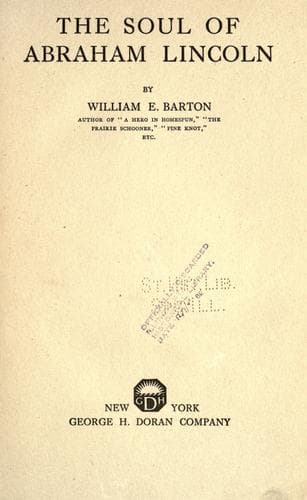
The Soul of Abraham LincolnBarton, William E. (William Eleazar)
Religion
The Soul of Abraham Lincoln
Barton, William E. (William Eleazar)
Lincoln, Abraham, 1809-1865 -- Religion; Presidents -- United States -- Biography
Such references as this show to us the instinctive place which he
accorded Jesus Christ in his own unpremeditated thinking. This was the
best thing he had to say about the Bible, that through it alone we have
knowledge of the Saviour of the world.
Herndon tells us that Lincoln ridiculed the doctrine of the virgin
birth of Jesus. If this is true, I am very sorry. But Abraham Lincoln's
faith in Christ did not depend wholly or even primarily upon his
interpretation of the mystery of our Lord's birth. I approach a
discussion of this question with some hesitation, for it is one which,
as related to Lincoln we do not know very much about, but it is a
subject which we are not free to pass over in silence.
It is a sad fact that the argument for the divinity of our Lord Jesus
Christ should ever have been based on the mystery of his birth. Not
thus does the New Testament establish the doctrine of his divinity.
The wonderful story of the birth of Jesus is told in two places
only,--in the introduction to the two Gospels of Matthew and Luke, and
these are the very two that contain genealogies tracing his descent
through Joseph. The theory that one of these gives the family tree of
Mary is unsupported by any evidence. So far as we know, Jesus never
referred to the mystery of his birth, or attached any importance to
it. His two brothers, James and Jude, each wrote a book which we have
in the New Testament, and there is no reference in either of them to
this doctrine. Peter preached his mighty sermons at Pentecost and
afterwards, proclaiming the faith on which the Church was established,
and he grounded his argument for the divinity of Jesus not upon his
birth, but upon his resurrection from the dead. Paul preached the
gospel of Christ throughout the Roman world, and neither in any
recorded sermon nor in any letter did he make any reference to that
dogma. Mark, earliest of the gospels, and for we know not how long a
period the only one, is silent as to the birth of Jesus; and John,
the most definitely spiritual of them all, begins and concludes his
profound philosophy of the person of Christ without a word concerning
the manner of his birth.
It is, therefore, a wholly unwarranted dogmatism which grounds the
divinity of Jesus in a question of the domestic relations of Joseph and
Mary. Jesus Christ is to be accepted for what He was and is, not for
some opinion as to how He became what He was.
Public-domain text, read in full here on John Shaqi.
Reviews
Reviews
No reviews yet
Be the first to share your thoughts on this work.
Elsewhere in the archive
Join the Discussion
Join the discussion
Sign in to leave a comment or review.
Sign InorCreate an account